Time is one of those funny little things that feels obvious until somebody asks, “Okay, but what time was it 27 minutes ago?” Suddenly the clock seems to have become a tiny puzzle sitting there on the wall, quietly judging us.
If the reference time is 9:40:04 PM on Sunday, September 20, 2026, then the answer is pleasantly simple: 9:13:04 PM.
So, 27 Minutes Ago From Now means moving backward by exactly 27 minutes from the stated present time. In this example, no hour, day, or date changes are needed, which makes the calculation rather neat.
The full result is September 20, 2026, 9:13:04 PM.
| Point | Answer |
|---|---|
| Current time | 9:40:04 PM |
| Subtract | 27 minutes |
| Time 27 minutes ago | 9:13:04 PM |
| Date | Sunday, September 20, 2026 |
| Simple answer | It was 9:13:04 PM. |
27 Minutes Ago From Now: The Exact Calculation
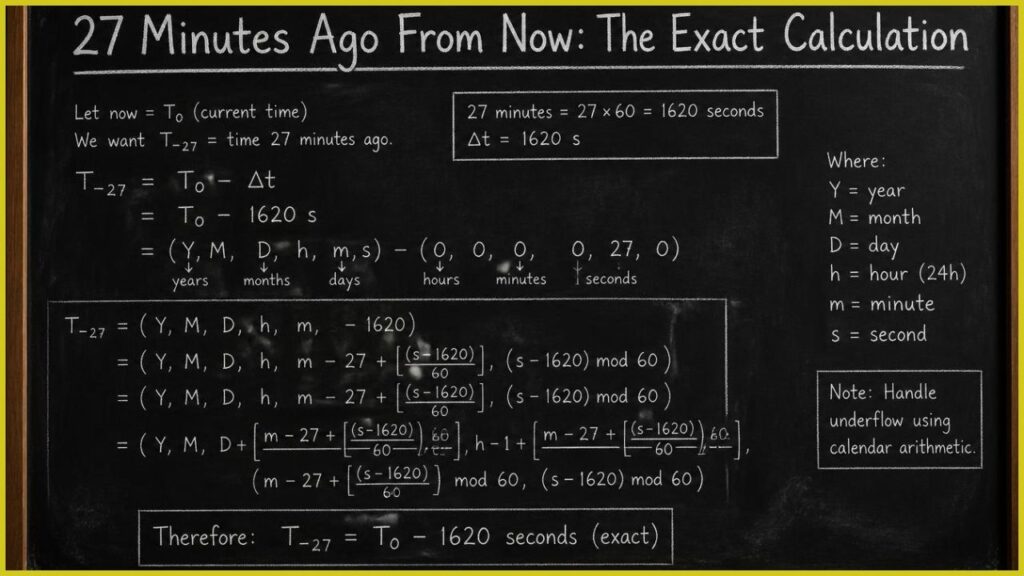
To calculate 27 minutes ago from now, take the current or reference time and subtract 27 minutes. Here, the starting point is 9:40:04 PM, and the operation is simply 9:40:04 PM − 27 minutes.
The seconds stay exactly where they are because we are only subtracting minutes, not seconds.
The calculation looks like this:
9:40:04 PM − 27 minutes = 9:13:04 PM
Therefore, the exact time 27 minutes ago was 9:13:04 PM on Sunday, September 20, 2026. Nothing mysterious happened to the date, thankfully; the clock only travelled backward inside the same evening.
This is the basic idea behind a time calculation, and it works whether you are doing it mentally, with a clock, or using a relative time calculator.
The important part is knowing the correct starting time first, becuase even a perfect subtraction gives the wrong answer when the reference time is wrong.
27 Minutes Ago From Now on September 20, 2026

Using the supplied reference date and time, September 20, 2026, 9:40:04 PM, the previous point is September 20, 2026, 9:13:04 PM. Both timestamps fall on Sunday, so there is no midnight crossing to make the calculation troublesome.
Think of the evening as a little road. At 9:40:04 PM you are standing at one point on it, and walking backward 27 minutes brings you to 9:13:04 PM.
That’s really all 27 minutes earlier means in practical terms, though clocks make it look more serious than it is.
The complete relationship can be written in one line:
Sunday, September 20, 2026, 9:40:04 PM → subtract 27 minutes → Sunday, September 20, 2026, 9:13:04 PM
This also explains why the answer to “what time was it 27 minutes ago?” should normally include the date when precision matters. A time such as 9:13 PM by itself can be ambiguous around midnight, travel, records, or international communication.
How to Calculate 27 Minutes Ago Without a Calculator
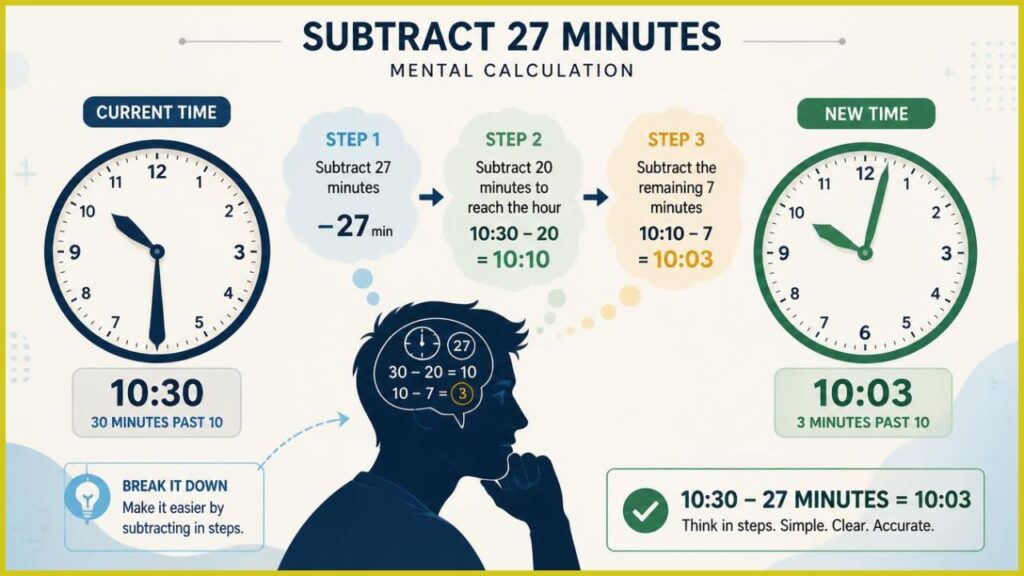
You don’t really need a minutes ago calculator for a simple interval like this. Start with the minute portion, 40, and subtract 27. The result is 13, while the hour remains 9. The seconds, 04, stay untouched.
So: 40 − 27 = 13
That gives 9:13:04 PM. It is almost comically easy once you see the structure, although people often overthink these little calculations when they’re checking a message timestamp or trying to remember when something happened.
If the starting minute had been smaller than 27, things would become slightly more interesting.
For example, subtracting 27 minutes from 9:10 PM would require borrowing one hour, turning 9:10 PM into 8:70 PM for the purpose of the calculation, then producing 8:43 PM. Clocks are a bit dramatic like that.
What Does “27 Minutes Ago” Actually Mean?

The phrase 27 minutes ago describes a point in the past that is separated from the reference moment by a 27 minute time interval. It is a relative expression, meaning its exact clock time depends entirely on when “now” is measured.
For example, if the current time is 9:40 PM, then 27 minutes earlier is 9:13 PM. But if the present time later becomes 10:15 PM, then 27 minutes ago will no longer be 9:13 PM. The phrase moves along with the present time, like a shadow that refuses to stand still.
That is why from now is so important. “27 minutes ago” and “27 minutes before now” express the same basic temporal relationship when they are referring to the same reference moment. The wording changes, but the mathematics doesn’t really care.
What Time Was It 27 Minutes Ago?
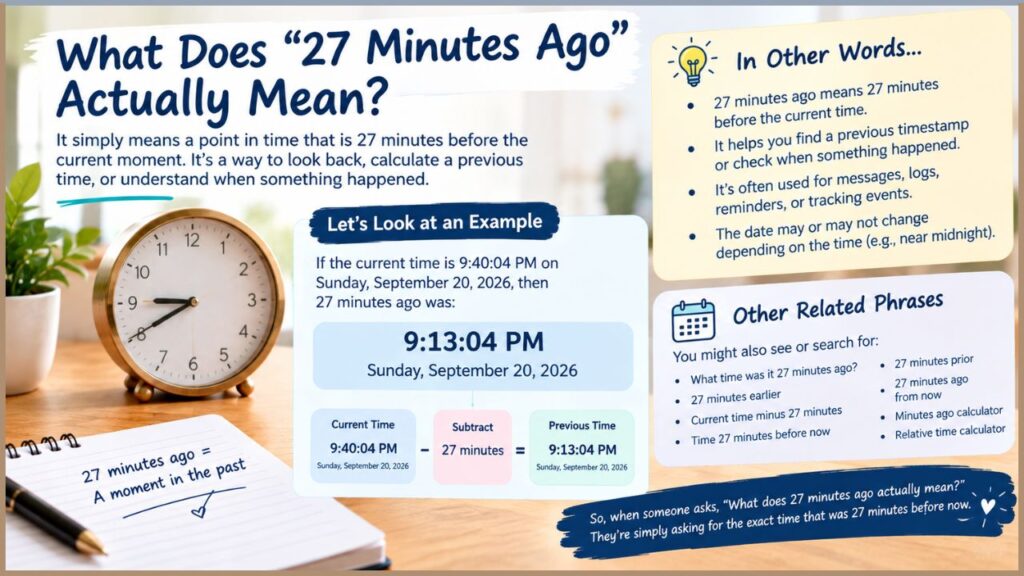
For the reference used in this article, the answer is clear:
What time was it 27 minutes ago?
It was 9:13:04 PM.
What was the date 27 minutes ago?
It was Sunday, September 20, 2026.
What was the full date and time 27 minutes ago?
It was September 20, 2026, 9:13:04 PM.
This is the useful distinction between a casual answer and an exact one. Saying “9:13 PM” is usually enough for ordinary conversation, while September 20, 2026, 9:13:04 PM is better for logs, records, timestamps, technical notes, or any situation where precision matters a little more.
27 Minutes Before Now: Why Seconds Usually Stay the Same
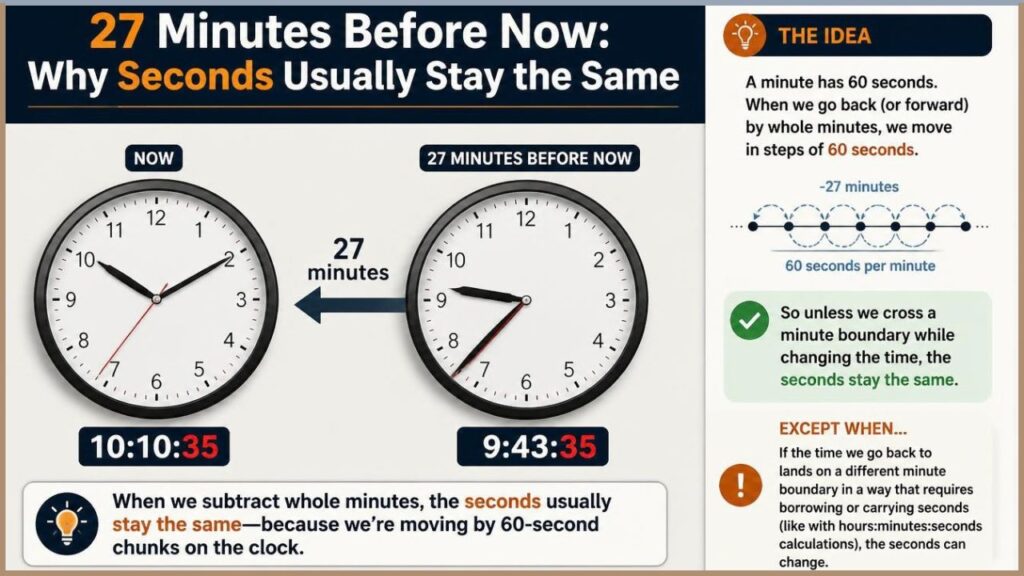
A common question with these calculations is whether the seconds should also change. They generally don’t when the instruction is specifically to subtract 27 whole minutes. Starting with 9:40:04 PM and moving backward 27 minutes leaves the seconds at 04.
So the movement is:
9:40:04 PM → 9:39:04 → 9:38:04 → … → 9:13:04 PM
The seconds are riding along quietly in the same position. It’s a small detail, but it matters when someone wants an exact time rather than an approximate one.
If the request instead said “27 minutes and 15 seconds ago,” then the seconds would obviously change too. Time calculations become much more fiddly when seconds are included, but the underlying idea remains the same: subtract the stated interval from the reference datetime.
27 Minutes Ago and the Idea of Relative Time
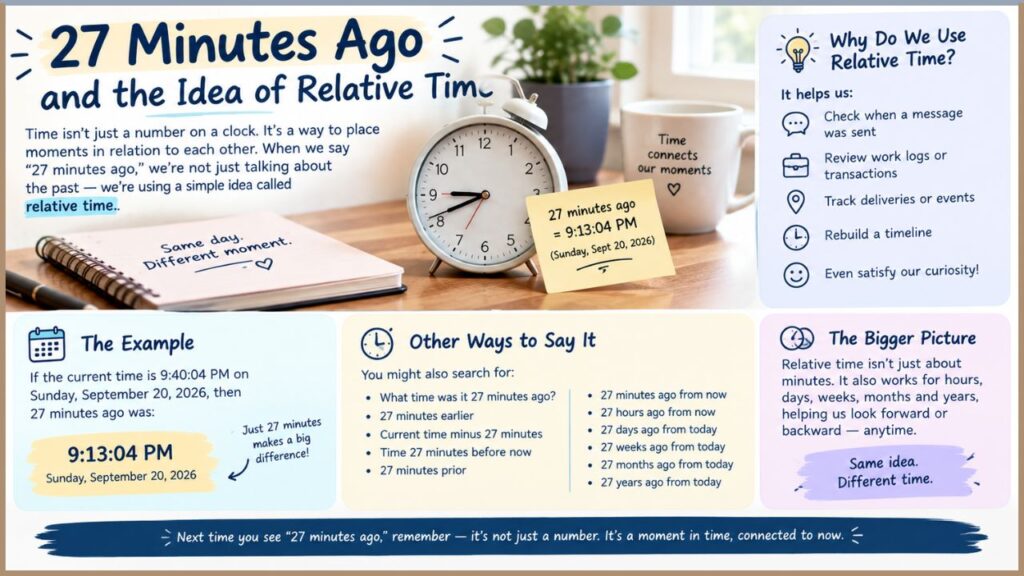
Relative time is everywhere. Messages say “5 minutes ago,” websites show “2 hours ago,” and social platforms sometimes tell you something happened “yesterday.” These expressions are convenient because humans don’t always want to stare at a complete timestamp.
The phrase 27 minutes ago from now belongs to exactly this family of expressions. It gives a distance from the present rather than presenting a fixed calendar date. That’s why a relative time calculator is useful for larger intervals, especially when hours, days, or dates start changing.
A relative timestamp can also become confusing around midnight. If it is 12:10 AM and you subtract 27 minutes, the answer is 11:43 PM on the previous calendar day. Suddenly the date and time both change, which is where simply looking at the minute hand can lead you into trouble.
What Happens When You Subtract 27 Minutes Near Midnight?

Imagine the current time is 12:10:00 AM on Monday. Subtracting 27 minutes gives 11:43:00 PM on Sunday. The clock moves backward, but so does the calendar date, which is an important part of accurate temporal calculation.
This is why a proper date time calculator does more than just subtract numbers. It understands that 12:00 AM is the beginning of a new day, not another version of the previous evening. Humans know this too, mostly, but our brains occasionally enjoy making midnight unnecessarily confusing.
For the supplied example, fortunately, none of that happens. 9:40:04 PM is comfortably far enough from midnight that subtracting 27 minutes leaves the date unchanged.
Minutes From Now, Hours From Now, and Days From Today
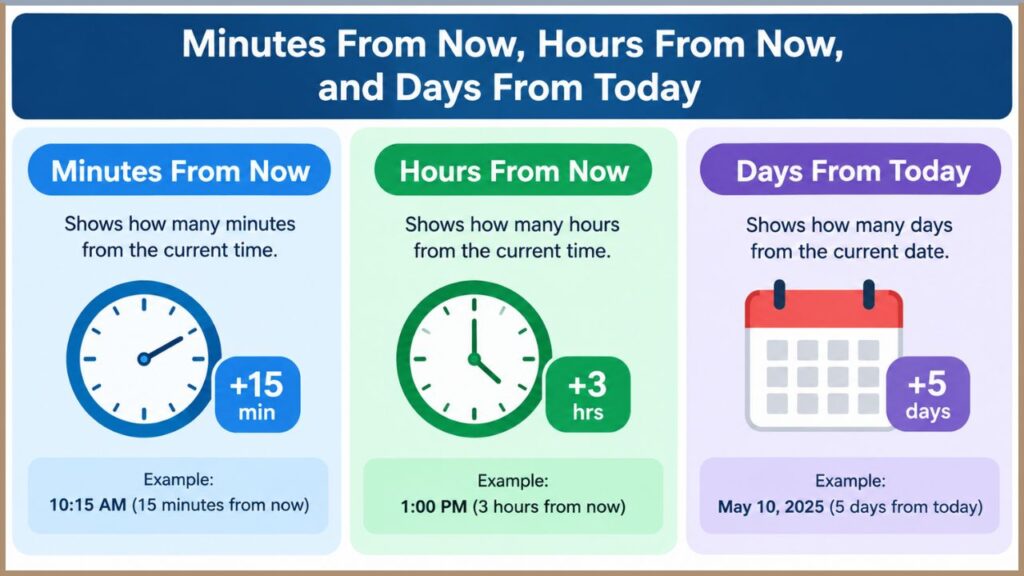
The same logic can be expanded beyond the small 27 minutes before now calculation. If you understand one interval, you can understand many others. The only thing that changes is the size of the interval being added or subtracted.
For future calculations, you might ask for:
- 27 minutes from now, meaning add 27 minutes to the present time.
- 27 hours from now, meaning move forward by 27 hours.
- 27 days from today, meaning move forward by 27 calendar days.
- 27 weeks from today, meaning move forward by 27 weeks.
- 27 months from today, meaning move forward by 27 calendar months.
- 27 years from today, meaning move forward by 27 calendar years.
For past calculations, the wording reverses direction:
- 27 minutes ago from now, meaning subtract 27 minutes.
- 27 hours ago from now, meaning subtract 27 hours.
- 27 days ago from today, meaning move backward 27 calendar days.
- 27 weeks ago from today, meaning move backward 27 weeks.
- 27 months ago from today, meaning move backward 27 calendar months.
- 27 years ago from today, meaning move backward 27 calendar years.
Notice that minutes and hours behave like fixed-duration intervals, while months and years need a little more care because calendar lengths aren’t identical. A month can be 28, 29, 30, or 31 days, which is the calendar’s mildly annoying way of keeping things interesting.
27 Minutes Earlier Than Now: A Simple Mental Shortcut
For everyday use, there is a quick mental trick for 27 minutes earlier than now. If the current minute is 27 or more, simply subtract 27 from the minute number and leave the hour alone. That’s exactly what happens with 9:40 PM.
Forty minus twenty-seven equals thirteen, so 9:40 PM becomes 9:13 PM. Add the seconds back in, and the precise answer becomes 9:13:04 PM. No app required, no complicated formula, no tiny laboratory coat needed.
If the current minute is less than 27, subtract one from the hour and add 60 to the minute before subtracting. It sounds more complicated than it feels in practice, and after doing it a few times the method becomes almost automatic.
Why Exact Timestamps Matter More Than They Seem

An exact timestamp 27 minutes ago can be useful when you are checking when an email arrived, comparing two events, documenting an activity, or trying to reconstruct the order of something that happened earlier. A vague “around 9 PM” doesn’t provide the same information.
For example, suppose one event happened at 9:13:04 PM and another happened at 9:40:04 PM. Their time difference is exactly 27 minutes. That’s much more useful than saying one happened “a little before” the other, especially in records where timing matters.
In ordinary life, we tend to round time because nobody wants to announce, “I arrived at 9:13:04 PM,” unless there is a very specific reason. Still, knowing how to recover an exact previous time is a handy little skill, and it takes almost no effort once the reference point is known.
Reed This Blog:-
Common Questions About 27 Minutes Ago
What time was 27 minutes ago?
Using 9:40:04 PM as the reference, the answer is 9:13:04 PM on September 20, 2026. The calculation is simply 9:40:04 PM minus 27 minutes, and nothing else needs changing.
What is 27 minutes before 9:40 PM?
It is 9:13 PM. If the original timestamp includes four seconds, then the precise result is 9:13:04 PM, which is a small but important distinction for exact records.
What date was 27 minutes ago?
With the reference date of Sunday, September 20, 2026, the date 27 minutes earlier remains September 20, 2026. There is no midnight crossing in this particular calculation, so the date stays put.
How do I calculate 27 minutes ago?
Take the present or reference time and subtract 27 minutes. If the minute value is at least 27, the calculation is straightforward; otherwise, borrow an hour before continuing.
Is 27 minutes ago the same as 27 minutes earlier?
Yes, when both expressions use the same reference moment. “27 minutes ago,” “27 minutes earlier,” and “27 minutes before now” describe the same 27-minute backward interval, give or take the wording.
Can a time calculator calculate this automatically?
Yes. A time ago calculator, minutes-before calculator, or relative date calculator can perform the subtraction automatically. For a simple 27-minute interval, though, manual calculation is often faster than opening a tool.
Does the date always stay the same?
No. If the subtraction crosses midnight, the date changes too. For the example here, 9:40:04 PM − 27 minutes remains on Sunday, so no date adjustment is necessary.
How to Calculate Time Ago Correctly Every Time
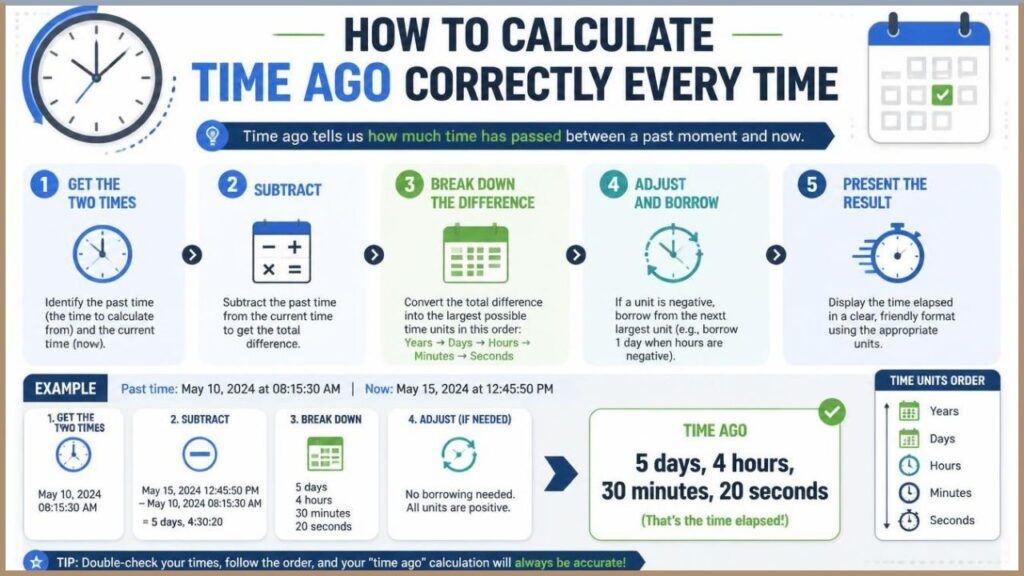
The first step is to identify the reference moment. Write down the current date and time rather than relying on a vague memory of when “now” was. Time is slippery, and even a couple minutes can matter in these calculations.
Next, identify the interval. Here, it is 27 minutes. Then subtract it from the reference time. If the subtraction crosses an hour boundary, borrow one hour; if it crosses midnight, move the date backward by one day.
Finally, check the result in plain language. For this example, ask yourself: “Does 9:13 PM really sit 27 minutes before 9:40 PM?” Yes, it does. That quick sanity check catches surprisingly many little arithmetic mistakes.
A Simple Formula for 27 Minutes Ago

You can express the whole process as:
Previous time = Current time − 27 minutes
For the supplied reference:
9:40:04 PM − 00:27:00 = 9:13:04 PM
And therefore:
September 20, 2026, 9:40:04 PM − 27 minutes = September 20, 2026, 9:13:04 PM
That’s the complete temporal calculation in its cleanest form. It looks rather formal written out, but underneath all those digits is just a clock moving backward by less than half an hour.
The Difference Between “Ago” and “From Now”
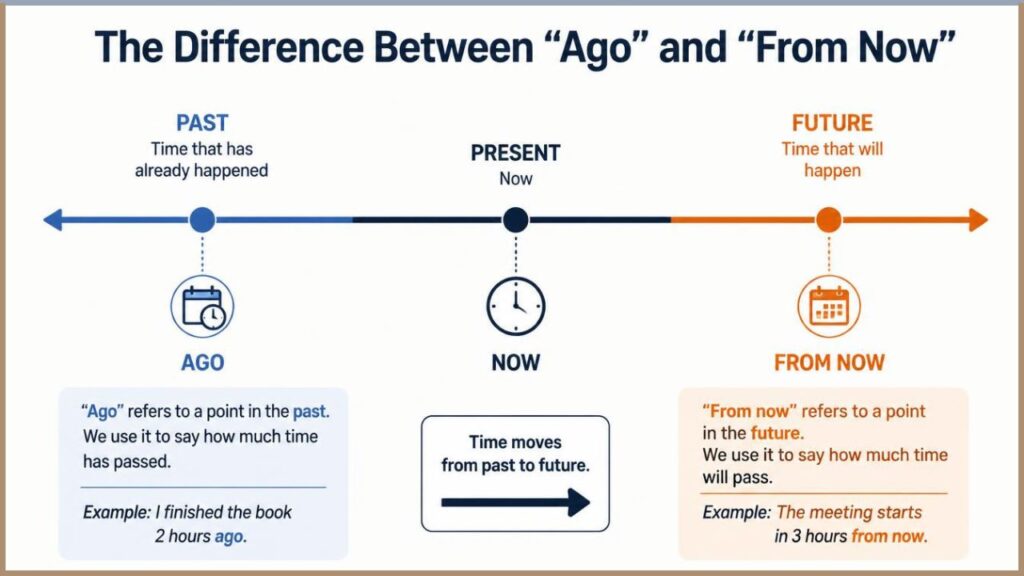
There is a tiny language distinction worth understanding. “Ago” normally points backward from the present, while “from now” often points forward when used alone. However, the phrase 27 minutes ago from now is commonly used in searches to mean “27 minutes before the present moment.”
In practical search intent, someone typing what time was 27 minutes ago wants the previous clock time. Someone asking what time will it be 27 minutes from now wants a future clock time. One moves backward, the other forward, and the reference point is the same concept: now.
This is also why search phrases such as current time minus 27 minutes, subtract 27 minutes from current time, and calculate 27 minutes ago all point toward the same basic operation. Different words, same little journey through the clock.
Final Answer: 27 Minutes Ago From Now
Using the reference time 9:40:04 PM on Sunday, September 20, 2026, the answer to 27 Minutes Ago From Now is:
September 20, 2026, 9:13:04 PM
The calculation is:
9:40:04 PM − 27 minutes = 9:13:04 PM
So if you searched for what time was it 27 minutes ago, wanted to calculate 27 minutes ago, or simply needed the current time minus 27 minutes, this is the precise result for the supplied reference timestamp.
Time calculations don’t need to feel like some grand mathematical ceremony. Start with the right reference, subtract the interval, check whether an hour or date boundary has been crossed, and write down the result clearly.
For this particular evening, the clock takes us from 9:40:04 PM back to 9:13:04 PM, exactly 27 minutes earlier.
And perhaps that’s the oddly comforting thing about a question this small: even when the present keeps running away from us, the past can still be found with a simple subtraction. Twenty-seven minutes is gone, but on a clock, at least, we know exactly where it went.