There is something oddly comforting about knowing exactly where a moment sits on the clock.
Maybe you are checking when a message was sent, trying to remember when you left home and simply wondering.
“Wait, what time was that again?” A tiny question such as 37 minutes ago from now can suddenly become a small puzzle, specially when the clock has moved on and your memory is doing its own creative editing. Time is sneaky like that, honestly.
In the example used for this article, the current timestamp is 7:09:35 PM on Wednesday, August 26, 2026. If we travel backward by 37 minutes ago, the answer is 6:32:35 PM on the same date.
It looks almost too simple when written down, but understanding the calculation makes related questions much easier, from “what time was it 37 minutes ago?” to “what is 37 minutes from now?” and even larger date calculations.
A clock doesnt need to be mysterious just because it has sixty little spaces.
| Item | Details |
|---|---|
| Current time | 7:09:35 PM |
| Subtraction | 37 minutes |
| Time 37 minutes ago | 6:32:35 PM |
| Date | Wednesday, August 26, 2026 |
| Calculation | 7:09:35 PM − 37 minutes = 6:32:35 PM |
What Does 37 Minutes Ago From Now Actually Mean?
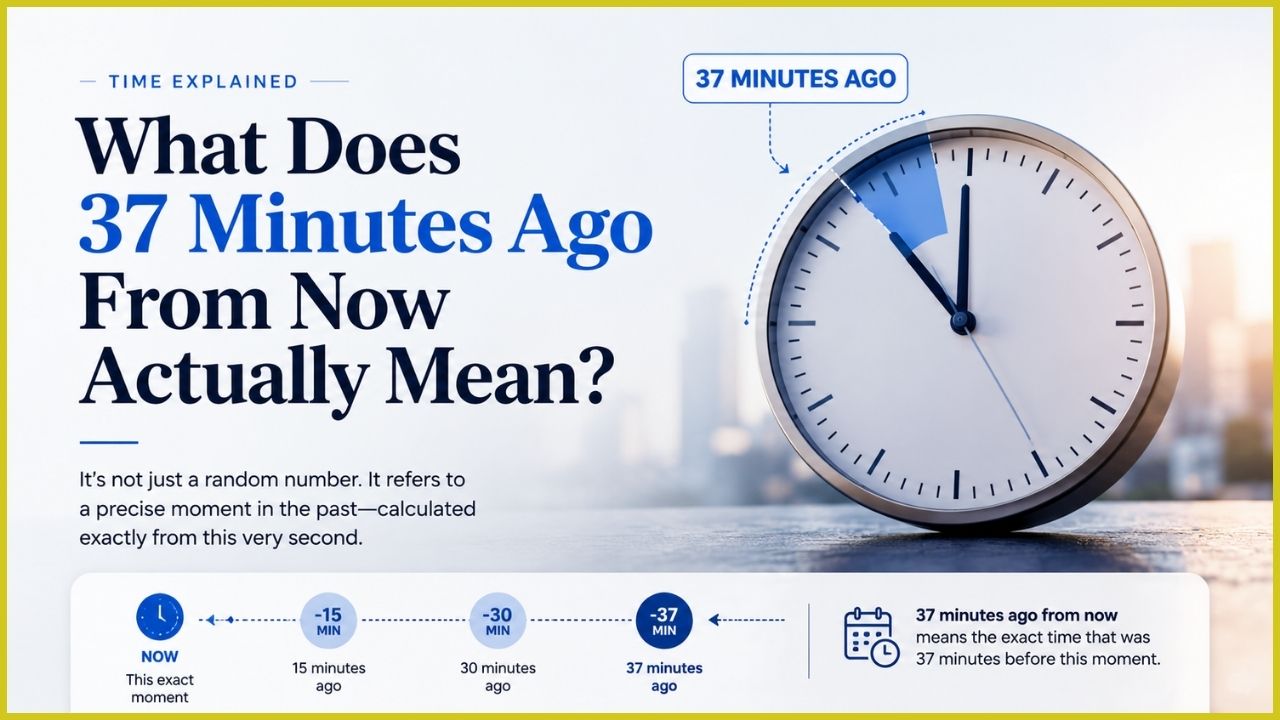
The phrase 37 minutes ago from now describes a point in the past that is exactly 37 minutes earlier than the current moment. The word “ago” tells us to move backward, while “now” gives us the reference point from which the movement begins.
It is basically a tiny journey through time, except thankfully there is no suitcase involved.
If now is 7:09:35 PM, then the task is simply to subtract 37 minutes from that clock time. Because the seconds remain unchanged, 7:09:35 PM − 37 minutes = 6:32:35 PM.
Therefore, the 37 minutes ago time in this example is 6:32:35 PM, and the date remains August 26, 2026, since the subtraction does not cross midnight. Easy enough, once the clock stops pretending to be clever.
The important relationship is therefore: Wednesday, August 26, 2026, at 7:09:35 PM is the starting timestamp, and Wednesday, August 26, 2026, at 6:32:35 PM is the previous timestamp.
That is a straightforward relative time calculation involving time subtraction, rather than a complicated calendar problem. Sometimes the most useful answer is the boringly exact one, and thats perfectly fine.
What Time Was It 37 Minutes Ago?
If you are asking what time was it 37 minutes ago, start with the hour and minute shown on the current clock. In this case, the current clock time is 7:09:35 PM. Subtracting 37 minutes takes us backward across the 7:00 mark, landing at 6:32:35 PM.
The seconds stay at 35 because we are subtracting minutes rather than seconds. Clocks are quite loyal about that little detail, even when humans forget it.
Here is the calculation in plain language:
- Current time: 7:09:35 PM
- Minutes to subtract: 37 minutes
- First move backward: 9 minutes takes us to 7:00:35 PM
- Remaining amount: 28 minutes
- Move backward another 28 minutes
- Result: 6:32:35 PM
So, what was the time 37 minutes ago? The answer is 6:32:35 PM on Wednesday, August 26, 2026, using the timestamp supplied for the calculation. If somebody asks you later, you can give the answer with suspiciously impressive confidence.
How to Calculate 37 Minutes Ago From Now
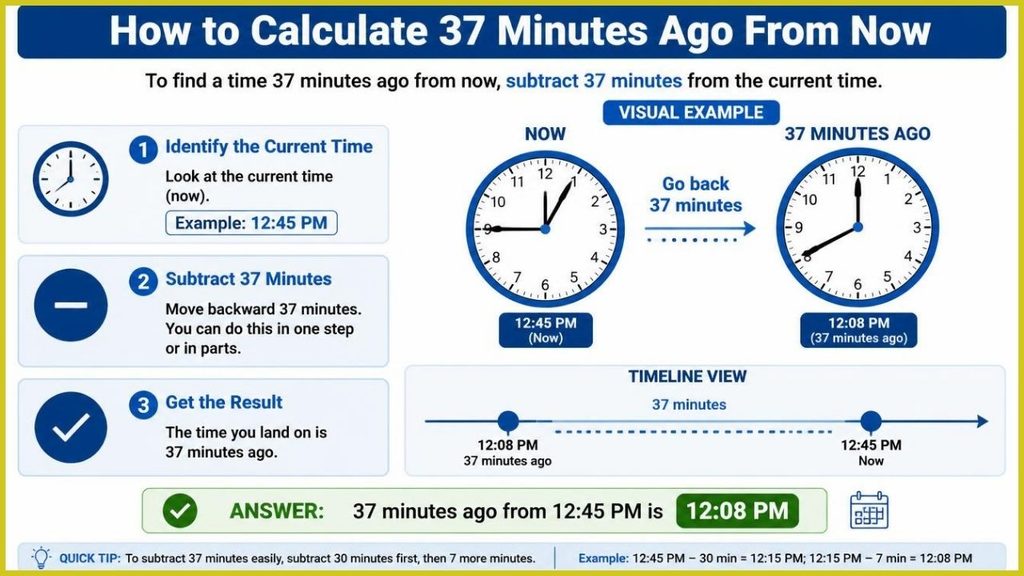
A simple method for finding 37 minutes ago from now is to subtract the number 37 from the current minute value. If the minute value is large enough, you can do this directly. If it is smaller than 37, you borrow one hour, turning that hour into 60 minutes before continuing the subtraction.
It sounds more dramatic than it really is, but borrowing an hour is the whole trick.
For the example 7:09:35 PM, the minute value is only 9, so subtracting 37 directly would produce a negative number. Instead, borrow one hour from 7 PM, turning the hour into 6 PM and the minutes into 69. Then subtract 37 from 69.
69 − 37 = 32
The result becomes 6:32:35 PM. Notice how the seconds, 35, did not change. This is a classic bit of time arithmetic, and once you understand the borrowing step, many “minutes before now” questions become almost automatic.
Your calculator may still deserve some credit though.
Another useful way is to break 37 into smaller pieces. Subtract 9 minutes from 7:09:35 PM to reach 7:00:35 PM, then subtract the remaining 28 minutes. That produces 6:32:35 PM.
This approach can feel easier when you’re doing the calculation mentally, particularly when the current minute is close to zero. Mental math sometimes likes a little theatrical staging.
37 Minutes Ago Time: Why the Date Matters
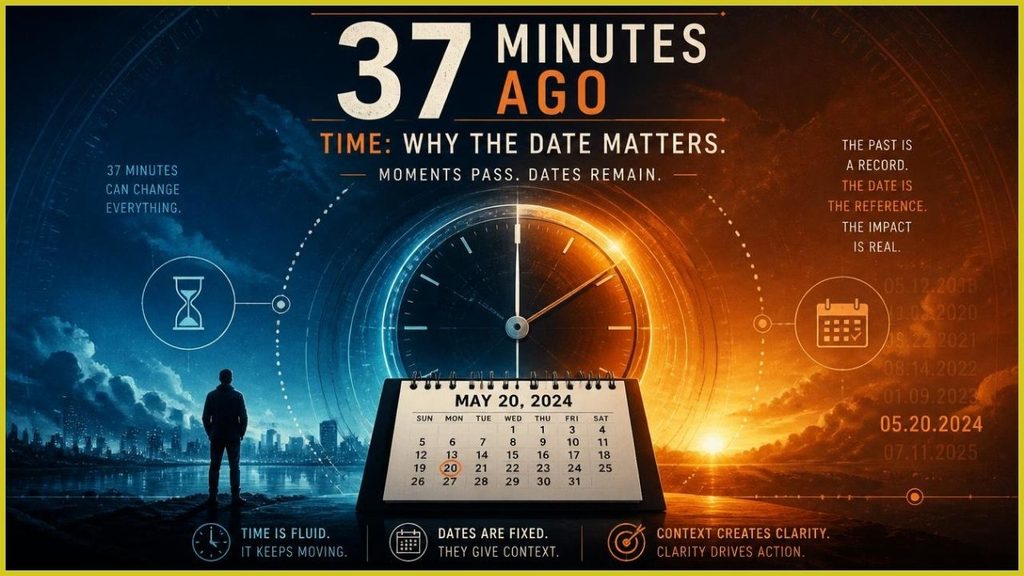
A 37 minutes ago time calculation usually stays on the same date, but that is not guaranteed. If the current time is shortly after midnight, subtracting 37 minutes can push the result into the previous calendar day.
That is where a simple clock calculation becomes a date and time calculation, because the answer now needs both a clock time and a date. Midnight is basically the border checkpoint of the time world.
In our example, 7:09:35 PM is comfortably inside the evening, so moving backward 37 minutes does not change the date. The final timestamp remains 26 August 2026, or August 26, 2026, depending on the date format being used.
The answer is therefore 6:32:35 PM on Wednesday, August 26, 2026. Nothing crosses midnight, so no calendar gymnastics are required, which is nice for everybody.
37 Minutes Ago Today and the Importance of a Reference Point

The phrase 37 minutes ago today sounds as though it always has one universal answer, but it actually depends on when “now” is measured. If one person asks at 7:09 PM and another asks at 11:45 PM, their answers will obviously be different.
Relative time is relative for a reason, and the reference point matters more than people sometimes expect.
That is why an accurate current time and, when necessary, a time zone are important. A timestamp from Islamabad may not represent the same local clock time as a timestamp from London or New York.
When precision matters, you need the starting timestamp before doing any subtraction. Otherwise, you are calculating with a clock that exists mostly in your imagination, which is not ideal.
37 Minutes Before Now: A Quick Mental Shortcut
When you need 37 minutes before now, there is a handy mental shortcut: subtract 40 minutes, then add 3 minutes back. For example, from 7:09 PM, subtracting 40 minutes gives 6:29 PM. Adding 3 minutes produces 6:32 PM.
The seconds remain unchanged if the original timestamp includes seconds, giving 6:32:35 PM in our example. It feels a bit like taking a scenic route to the same house.
Another shortcut is to subtract 30 minutes first and then subtract 7 more minutes. From 7:09:35 PM, thirty minutes takes you to 6:39:35 PM. Seven additional minutes gives 6:32:35 PM.
Breaking a number into friendly chunks can make a quick time calculation less annoying, specially when you are doing it without a phone.
What Is 37 Minutes From Now?
Past and future calculations are mirror images. If 37 minutes ago means moving backward by 37 minutes, then 37 minutes from now means moving forward by 37 minutes.
Using the same starting time of 7:09:35 PM, adding 37 minutes gives 7:46:35 PM on August 26, 2026.
The calculation is simple because 9 + 37 = 46, so there is no need to carry an hour. The future timestamp is therefore 7:46:35 PM.
This distinction between past and future is worth remembering because the words “ago” and “from now” completely change the direction of the calculation, even though the number 37 stays exactly the same.
One tiny phrase can send the answer backward or forward, which is kind of funny.
37 Hours From Now, 37 Days From Today, and Other Relative Questions

The same idea extends far beyond minutes. 37 hours from now requires adding one full day and another 13 hours, while 37 days from today requires actual calendar arithmetic because months have different lengths.
You cannot safely treat every month as though it were made from the same number of days, no matter how cooperative that would be.
Likewise, 37 weeks from today equals 259 days, because a week contains seven days. But 37 months from today is best handled by moving through calendar months rather than multiplying by an assumed number of days.
And 37 years from today means moving the calendar year forward by 37, while still paying attention to the exact month and day. Calendar math gets slightly fussier as the number grows, as calendars tend to do.
For the reverse direction, 37 hours ago from now, 37 days ago from today, 37 weeks ago from today, 37 months ago from today, and 37 years ago from today all use the same basic principle: identify the reference date or timestamp, determine the unit, and move backward by the specified amount.
The unit changes, but the logic doesnt really change.
A Simple Time Calculator Method Anyone Can Use

A time calculator can perform these calculations instantly, but knowing the manual method is still useful. Start by writing the full timestamp, including the date if there is any possibility that the calculation could cross midnight.
Then decide whether the operation is addition or subtraction. Finally, adjust hours and minutes while keeping the seconds consistent when only whole minutes are being changed.
For current time minus 37 minutes, the operation is:
7:09:35 PM − 00:37:00 = 6:32:35 PM
This format makes the calculation easy to inspect. It also reduces the chance of accidentally subtracting 37 hours or 37 seconds when you meant 37 minutes.
A little written structure can save a surprisingly silly mistake, and yes, we have all made those.
Why Exact Seconds Can Matter
People often ask for the “exact time” and then provide a timestamp containing seconds, such as 7:09:35 PM. In that situation, keeping the seconds is appropriate because subtracting 37 whole minutes does not alter the seconds.
The answer should therefore preserve the 35-second component: 6:32:35 PM.
If the starting time were only 7:09 PM, however, pretending that the answer somehow contains meaningful seconds would create false precision.
A good timestamp calculation should not invent information that was never provided. Accuracy is not about adding more digits; it is about respecting the digits you actually have, which is a small rule but a pretty important one.
Common Mistakes When Subtracting 37 Minutes
One common mistake is forgetting to borrow an hour when the current minute is less than 37. Starting from 7:09 and writing 7:(9−37) creates a negative minute value, which tells you immediately that the calculation needs adjustment.
The answer isnt 7:28, obviously, though clocks would have some explaining to do if they worked that way.
Another mistake is changing the seconds unnecessarily. If the starting timestamp is 7:09:35 PM and the question asks for 37 minutes ago, the seconds remain 35.
A third mistake is ignoring the date when the subtraction crosses midnight. A reliable date and time calculator handles this automatically, but manual calculations still require a little attention.
The Difference Between Relative Time and Absolute Time
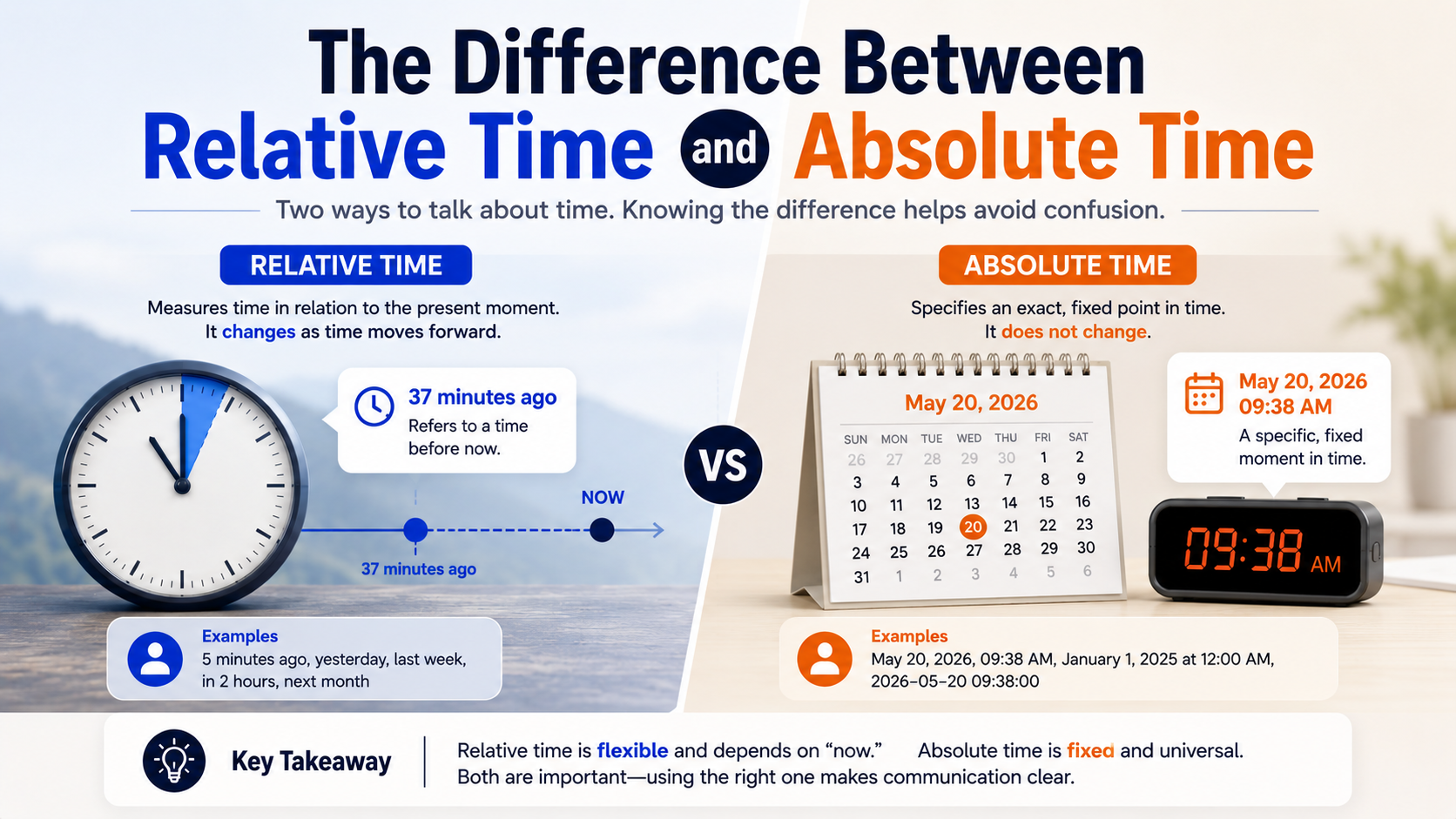
An absolute timestamp gives a specific point, such as Wednesday, August 26, 2026, at 7:09:35 PM. A relative expression such as 37 minutes ago does not stand alone; it depends on the moment from which it is measured.
Without the reference point, the phrase has no single permanent answer.
That distinction explains why online searches for “what time was it 37 minutes ago?” can sometimes produce confusing results. The answer changes continuously because “now” changes continuously.
A result that is correct at 7:09 PM will be different at 7:10 PM. Time calculations are wonderfully honest in that regard: they refuse to sit still, which is rather inconvenient but also the whole point.
When a 37-Minute Calculation Is Actually Useful
A 37-minute prior timestamp can be useful in everyday situations that have nothing to do with complicated mathematics. You might be checking a delivery notification, reconstructing a sequence of events, reviewing a work log, comparing timestamps in a conversation, or remembering when an appointment reminder appeared.
These tiny calculations help turn fuzzy memory into a clearer timeline.
Imagine receiving a message at 7:09:35 PM and wondering when the person sent something 37 minutes earlier. The answer, using this reference point, is 6:32:35 PM. Suddenly a vague “sometime earlier” becomes an exact reference time.
It is a small difference, but small differences are often what make a timeline make sense.
37 Minutes Earlier: A More Natural Way to Say It
In everyday conversation, people may say 37 minutes earlier, 37 minutes prior, or 37 minutes before now instead of “37 minutes ago.”
These expressions generally describe the same backward movement through time when the reference point is understood. The wording changes, but the arithmetic stays put.
For example, “The event happened 37 minutes earlier” and “The event happened 37 minutes ago” can both point to 6:32:35 PM when the reference timestamp is 7:09:35 PM.
The important thing is knowing what event or timestamp the phrase refers to. Without that context, relative time can become a little slippery, like a bar of soap in a bathtub.
A Broader Relative Date and Time Calculator Perspective
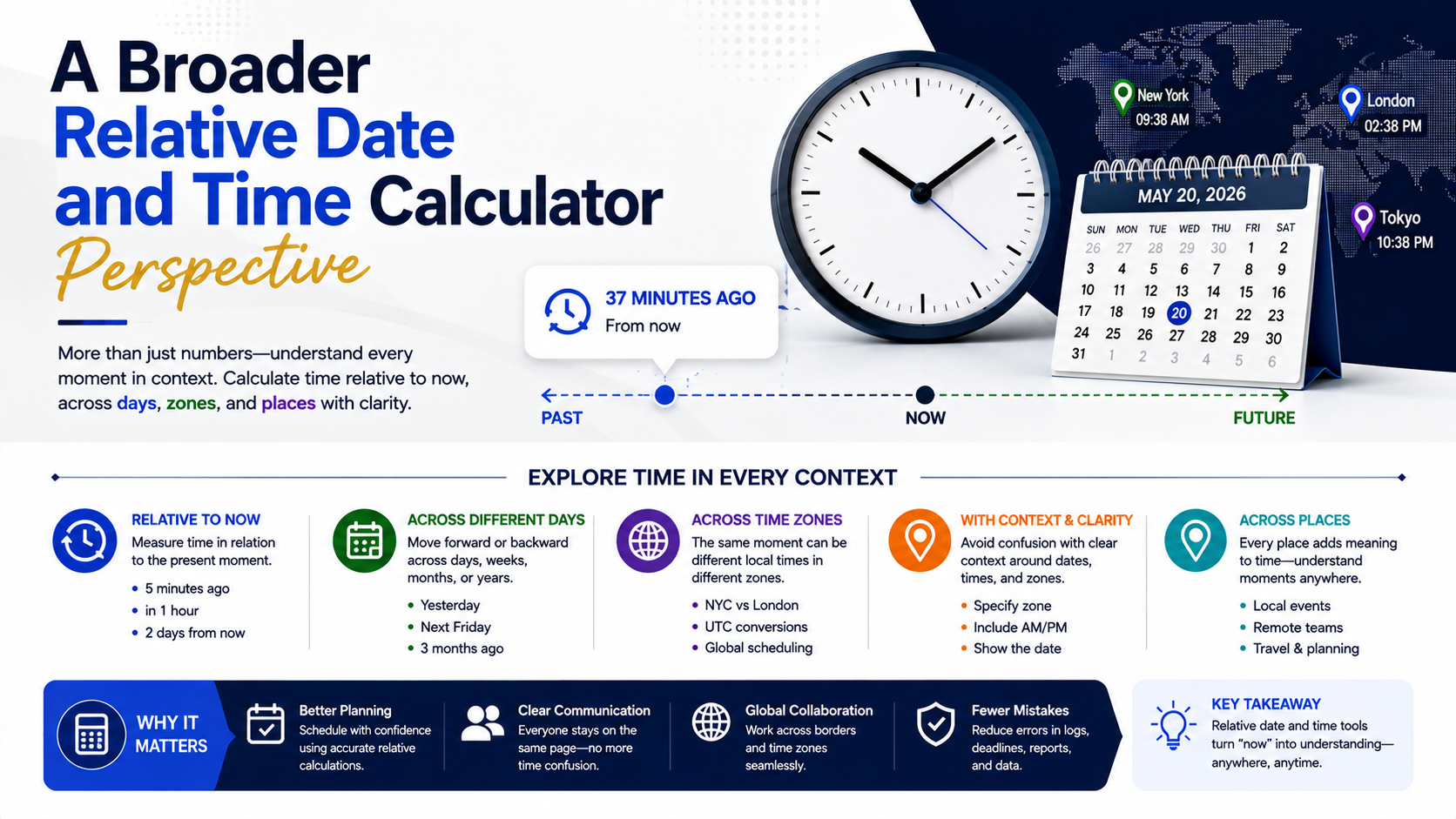
The question 37 minutes ago from now belongs to a much larger family of temporal questions.
People regularly want to know how many minutes have elapsed, what time occurred a certain number of hours earlier, or what date will arrive after a particular number of weeks. These are all forms of relative time calculation.
The same framework works for seconds, minutes, hours, days, weeks, months, and years, although larger units require more awareness of calendars.
A minutes ago calculator is simple because minutes have a fixed relationship with hours. A months ago calculator is more complicated because months do not all contain the same number of days.
Time looks uniform on a clock, but calendars quietly refuse to cooperate.
A Quick Reference for the Given Example
For the exact scenario described here, the essential information can be kept very short. The reference timestamp is 7:09:35 PM on Wednesday, August 26, 2026. Subtracting 37 minutes produces 6:32:35 PM, still on Wednesday, August 26, 2026.
So if someone asks, “What time was it 37 minutes ago?”, the answer is 6:32:35 PM. If they ask “What was the time 37 minutes ago from now?”, the answer is the same, provided “now” refers to the stated 7:09:35 PM timestamp.
Context is doing a lot of quiet work here, more than it gets credit for.
How to Make Your Own Time Calculation More Reliable

When performing a past-time calculation, write down the reference time first instead of trying to hold it in your head. Then write the amount to subtract, such as 00:37:00.
If the minutes are smaller than the number you need to subtract, borrow an hour. Finally, check whether the calculation crossed midnight and therefore changed the date. This method is boring, but boring is often excellent for accuracy.
For online tools, a time ago calculator or date and time calculator can be useful when you are working with several timestamps.
Just make sure the tool is using the intended time zone and date. A calculator can perform arithmetic perfectly and still give an unhelpful answer if the starting information is wrong, which is a rather human problem for a machine.
Frequently Asked Question
What time was it 37 minutes ago
37 minutes ago means the current time minus 37 minutes. For example, if it is 9:32 PM now, it was 8:55 PM.
37 minutes ago from now
To calculate 37 minutes ago from now, simply subtract 37 minutes from the current time.
What time was 37 minutes ago
The time 37 minutes ago is found by subtracting 37 minutes from the current time.
What time was it 37 hours ago
37 hours ago means going back 37 hours from the current date and time, or 1 day and 13 hours.
What time was it 37 min ago
“37 min ago” means 37 minutes before the current time. Subtract 37 minutes to get the exact time.
Conclusion: Sometimes One Small Time Question Has a Very Exact Answer
The answer to 37 minutes ago from now is wonderfully straightforward when the reference point is known. With a starting time of 7:09:35 PM on Wednesday, August 26, 2026, subtracting 37 minutes gives 6:32:35 PM on the same day.
The calculation is simply time subtraction, but it demonstrates a useful principle: relative time only makes sense when we know what “now” means.
Whether you are checking 37 minutes ago, calculating 37 minutes from now, or moving into questions involving 37 hours, 37 days, 37 weeks, 37 months, or 37 years.
The underlying idea remains familiar: identify the reference point, choose the direction, apply the correct unit, and check the date when necessary. That’s really all there is to it.
And perhaps that is the nicest thing about a small time calculation: it takes a moment that has already disappeared and gives it a precise little address on the clock. 6:32:35 PM is no longer merely “some time earlier”; in this example, it has a place, a date, and a relationship to now.
Time keeps moving, naturally, but sometimes we can pause long enough to name where we were 37 minutes before.