There is something oddly satisfying about asking a simple calendar question and watching a vague future moment turn into one exact little square on the calendar.
If Today is Monday, September 14, 2026, then asking “what date is 20 weeks from today?” has a wonderfully precise answer: Monday, February 1, 2027. It sounds far away at first but 20 weeks is really just 140 days and somehow the calendar makes that distance feel both big and surprisingly small.
This guide is for anyone trying to calculate 20 weeks from today, check a future appointment, plan an event, understand a deadline, or simply satisfy that nagging calendar curiosity.
The calculation is straightforward, though date counting can get a little slippery when months have different lengths, so it helps to use a proper date calculation rather than guessing by looking at the months.
| Calculation | Result |
|---|---|
| Today / Starting Date | Monday, September 14, 2026 |
| Duration | 20 weeks |
| 20 Weeks in Days | 140 days |
| 20 Weeks From Today | Monday, February 1, 2027 |
| Target Date | February 1, 2027 |
The Quick Answer: 20 Weeks From Today

If the starting date is Monday, September 14, 2026 adding 20 weeks gives us Monday, February 1, 2027. That is the direct answer to the question, “What date will it be 20 weeks from today?” Nothing mysterious hiding behind the calendar here, thankfully.
September 14, 2026 → +20 weeks → February 1, 2027
Because one week contains seven days 20 weeks = 140 days. So you can reach the same result either by adding 20 weekly intervals or by adding 140 individual days.
The first method is much easier on the brain, honestly, because nobody wants to count 140 tiny boxes unless they really have to.
For readers searching for a 20 weeks date calculator, the important pieces are simply the starting date, the number of weeks, and whether you are moving forward or backward. Put those together and the calendar does its little magic trick.
What Date Is 20 Weeks From Today?
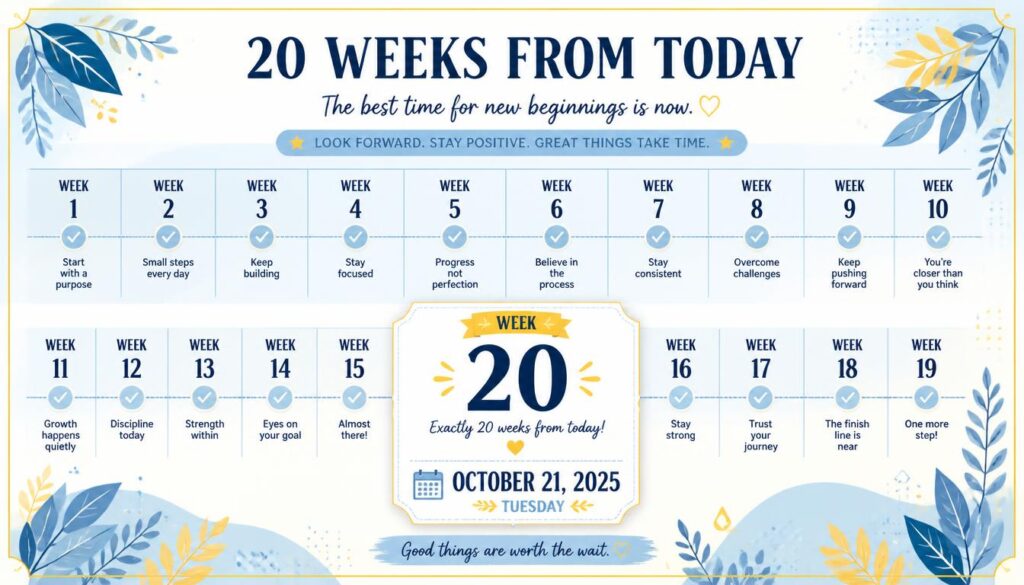
Using September 14, 2026 as the reference date, the future date is February 1, 2027. The day remains Monday because adding a complete number of weeks does not change the weekday.
This is one of the nicest shortcuts in any weekly date calculation, and it makes checking the answer much easier.
So, if someone asks, “What is the date 20 weeks after September 14 2026?” the answer is February 1, 2027. If they ask, “What day is 20 weeks from today?” the answer is Monday. Two questions, one tidy calendar result.
The calculation can be written very simply:
- Starting date: Monday, September 14, 2026
- Duration: 20 weeks
- Equivalent duration: 140 days
- Future date: Monday, February 1, 2027
- Calendar movement: Forward
- Weekday after 20 weeks: Monday
It is worth remembering that “20 weeks from now” and “20 weeks from today” normally describe the same future interval when the reference point is today. The exact clock time can matter for some applications, but for a normal calendar date, the result is February 1, 2027.
How to Calculate 20 Weeks From Today
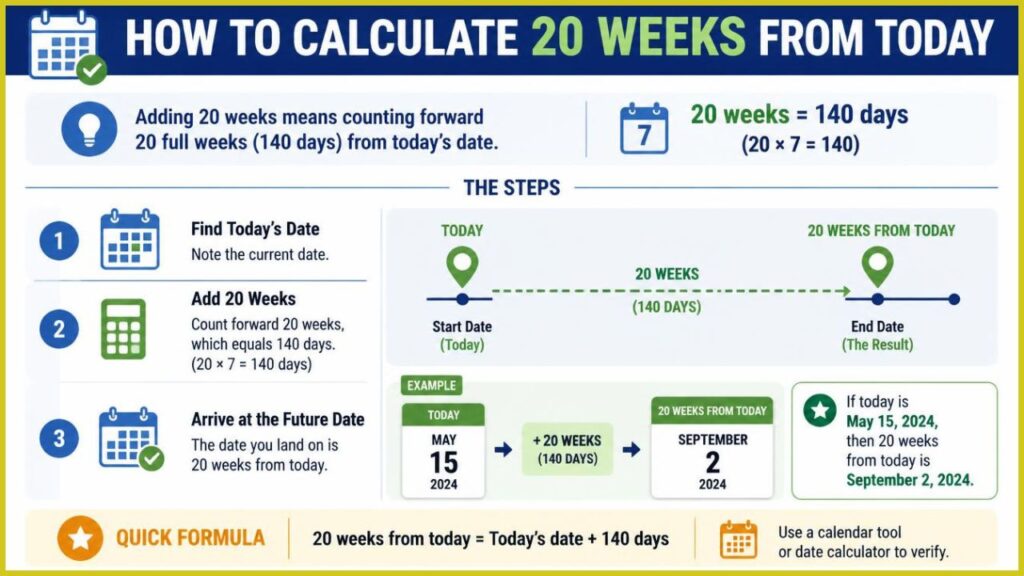
A simple way to calculate 20 weeks from today is to multiply the number of weeks by seven. Since 20 × 7 equals 140, the problem becomes a 140-day date calculation.
You then move forward 140 days from the starting date, which lands on February 1, 2027.
There is another useful method: move forward one week at a time. From Monday, September 14, every seven days brings you to another Monday, and after twenty such jumps you arrive at Monday, February 1.
It takes a little longer on paper, but it is a nice method when you’re checking a date without a calculator.
A digital date calculator is helpful when you need to calculate several intervals, especially if the dates are years apart. Still, understanding the basic arithmetic means you can verify the result yourself instead of blindly trusting whatever number appears on the screen, which is a pretty useful habit.
20 Weeks From September 14, 2026
The phrase 20 weeks from September 14 2026 is especially important here because September 14, 2026 is the chosen starting point. Adding a 20-week duration to that reference date produces February 1, 2027, with no awkward adjustment needed.
The calendar path crosses the end of September, all of October, November, December, and January before reaching February.
Notice that you should not simply add “20” to the September date or estimate by months, because a week is a fixed seven-day duration while months are not fixed lengths. Calendars enjoy making that distinction slightly annoying.
Here is the calculation in its cleanest form:
September 14, 2026 + 140 days = February 1, 2027
That means February 1st 2027 is also the correct answer if you search using the ordinal spelling rather than the standard date format. Different wording, same calendar square.
20 Weeks From Today in Days
One of the easiest ways to understand 20 weeks is to translate the duration into days. Every week contains seven days, so:
20 × 7 = 140 days
Therefore, 20 weeks from today is the same interval as 140 days from today. This relationship is particularly useful when comparing a weekly schedule with a daily schedule, because it keeps the calculation consistent instead of mixing different units.
The word “today” is important, though. A relative date changes whenever the reference date changes. If you perform the same search tomorrow, the answer will naturally move forward by one day.
That’s why a relative date calculator always needs a clearly defined starting point.
Why the Weekday Stays the Same

There is a neat little calendar fact hiding inside this calculation: adding a whole number of weeks never changes the weekday. Since September 14, 2026 is a Monday, twenty complete weeks later is also Monday. It is almost like the calendar is politely refusing to surprise us for once.
The reason is simple. Seven days brings you back to the same weekday. Fourteen days does too, and so does 140 days because 140 is exactly 20 groups of seven. Therefore, Monday, February 1, 2027 follows naturally from Monday, September 14, 2026.
This is also a handy way to check a future-date calculation. If your calculator tells you that 20 weeks after a Monday is a Thursday, something has gone a bit sideways.
Comparing 20 Weeks With Other Relative Dates
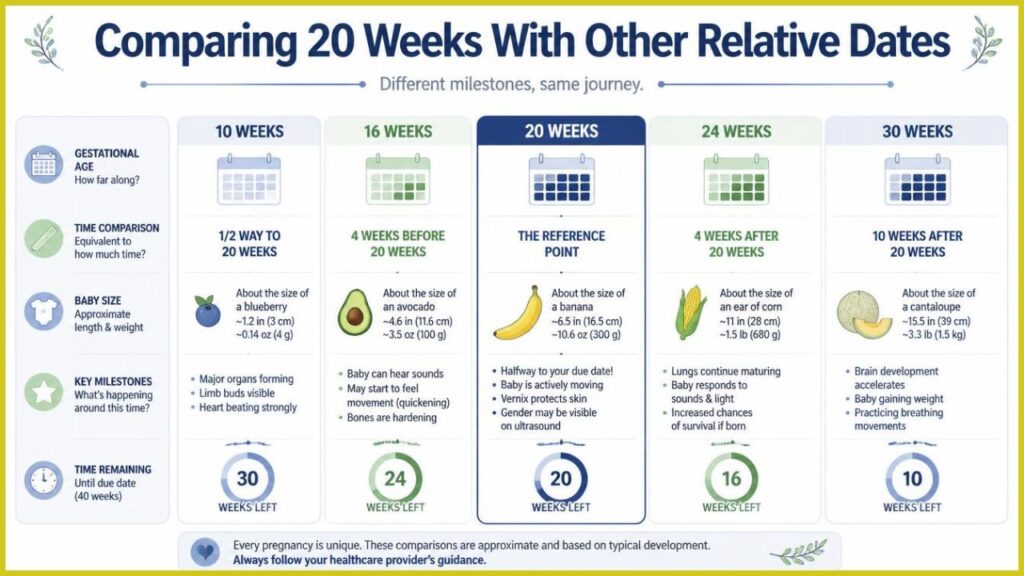
People often search for several related calculations around the same time, such as 20 days from today, 20 months from today, or 20 years from today. These sound similar but represent very different intervals, because days, weeks, months, and years do not behave identically on a calendar.
For example, 20 weeks equals exactly 140 days. Twenty months, however, cannot simply be converted into one universal number of days because months have different lengths. Twenty years also depends on leap years if you’re trying to determine the exact number of days.
The same idea applies when moving backward. 20 weeks ago from today means subtracting 140 days from the reference date, while 20 days ago from today means subtracting only 20 days. Relative time is simple once the unit is kept firmly in view, but it gets confusing when the units start swapping seats.
What About 20 Minutes From Now or 20 Hours From Now?
The phrase 20 Minutes from now is a relative-time calculation, but it is not normally a calendar-date question. If you are working from a particular clock time, you add 20 minutes to that exact moment.
The result may stay on the same date or cross into the next one, depending on the starting time.
Similarly, 20 Hours from now requires both a date and a clock time for a fully precise answer. Twenty hours is less than a day, but it can still push the clock into tomorrow. This is why a time calculation is slightly different from a basic date calculation.
The same applies to past expressions such as 20 Minutes ago from now and 20 Hours ago from now. They describe elapsed time relative to a current moment, while “20 weeks from today” is usually concerned with a calendar date rather than the exact minute.
20 Weeks Later: Understanding the Future Date

The phrase 20 weeks later simply means the calendar point reached after twenty complete weekly intervals. In this example, the future date is February 1, 2027. Saying “20 weeks later” and saying “140 days later” therefore identifies the same destination.
This can be useful for planning milestones, appointments, projects, study schedules, or personal deadlines. Instead of saying “sometime around February,” you can give the exact target date and avoid the small cloud of uncertainty that vague calendar language creates.
A future date calculator can make this even easier when you are working with several starting dates. But for a single calculation like this one, knowing that 20 weeks equals 140 days is more than enough to get the job done.
20 Weeks From Today vs. 20 Weeks Ago From Today

Moving forward and moving backward are mirror-image calculations. Starting from September 14, 2026, adding 20 weeks produces February 1, 2027, while subtracting 20 weeks gives a date in May 2026.
The direction matters, obviously, but it is surprisingly easy to forget when typing a quick search.
The phrase 20 weeks ago from today refers to the past, while 20 weeks from today points toward the future. Both use the same 140-day interval, just in opposite directions.
This is one reason a good date finder or calendar tool should clearly label whether you are adding or subtracting time.
One tiny direction change can move the answer from a future plan to a historical date, which is not the sort of surprise you want on a deadline.
How a Date Calculator Handles the Calculation

A reliable 20 week date calculator does not need to estimate months. It treats the week as a fixed seven-day duration and adds the required number of days to the starting date. For 20 weeks, that means adding 140 days.
A typical calculation follows three basic steps:
- Identify the starting date or reference date.
- Convert the number of weeks into days by multiplying by seven.
- Add the resulting number of days to find the target date.
This approach is dependable because it avoids the irregular lengths of calendar months. A month might have 28, 29, 30, or 31 days, whereas a week always behaves itself and contains seven. If only every calendar unit were this cooperative.
Related Calculations You May Want to Check

Once someone searches for 20 weeks from now, they often become curious about nearby relative-date questions. The same principle can answer many of them, although the units need to be handled separately.
For example, 20 days from today means adding exactly twenty days. 20 months from today means moving twenty calendar months forward, while 20 years from today means moving twenty calendar years forward.
They sound like siblings, but each follows slightly different calendar rules.
The past versions work in the same way. 20 days ago from today, 20 weeks ago from today, 20 months ago from today, and 20 years ago from today all identify earlier points relative to the same reference date.
The key is always the same: identify the starting point first, then apply the correct duration.
A Quick Reference for the Main Answer

If you only needed the essential information, this small reference is the part to remember. The reference date is Monday, September 14, 2026, the interval is 20 weeks, and the result is Monday, February 1, 2027.
In other words, the complete calendar calculation is:
Monday, September 14, 2026 + 20 weeks = Monday, February 1, 2027
Since 20 weeks = 140 days, you can also phrase it as 140 days from September 14, 2026. Both routes lead to the exact same future date, which is rather reassuring when you are checking an important calendar detail.
Common Mistakes When Calculating 20 Weeks From Today
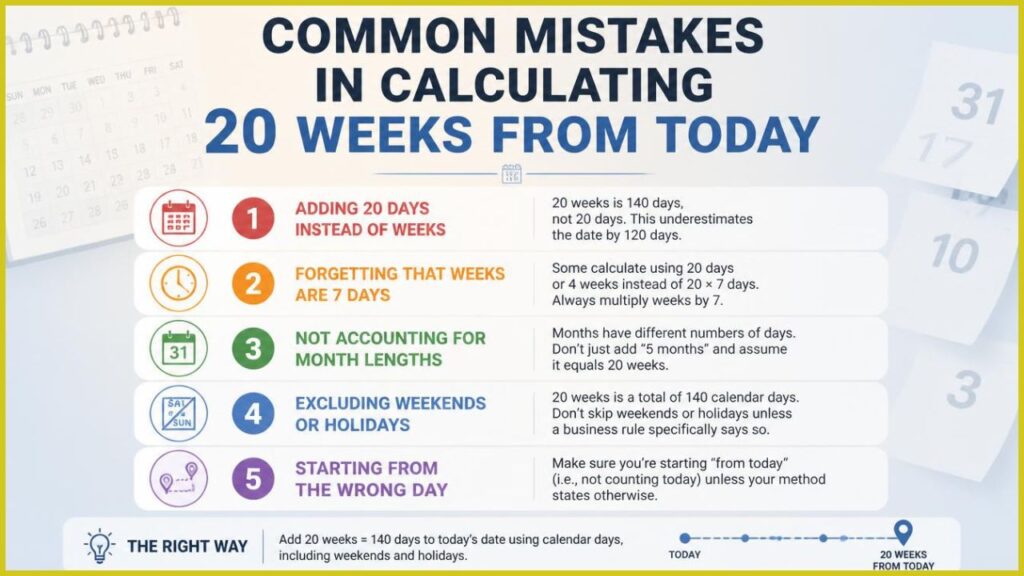
One common mistake is treating 20 weeks as roughly five months and then adding five months to the starting date. That’s tempting, but it isn’t a precise calculation because five calendar months do not always contain exactly 20 weeks.
Calendar arithmetic likes precision more than approximation, apparently.
Another mistake is counting the starting day as “day one” when doing a manual calculation. Standard date addition treats the starting date as the reference point and then moves forward by the required number of days.
This distinction can create an off-by-one error if you’re counting boxes on a calendar.
A third mistake is forgetting that “today” changes. September 14, 2026 is the reference date for this example, so the answer February 1, 2027 belongs specifically to that starting date. Search the same question on another day and your future date will move accordingly.
The Simple Answer to the Search Query

For anyone typing “what date is 20 weeks from today?”, assuming Today is Monday, September 14, 2026, the answer is Monday, February 1, 2027.
For the search “what is 20 weeks from now?”, the answer is likewise February 1, 2027, provided “now” is being interpreted from the same September 14, 2026 reference date. The calendar doesn’t care which wording you use; it only cares where you start and how far you travel.
For “date after 20 weeks”, “20 weeks later date”, or “date 20 weeks from today”, the same result applies: February 1, 2027. One duration, one starting point, one destination. Nice and clean.
Frequently Asked Question:
What is 20 weeks from now
20 weeks from September 14, 2026, is February 1, 2027.
What is the date 20 weeks from today
The date 20 weeks from today is February 1, 2027.
20 weeks from.today
20 weeks from today falls on February 1, 2027.
What day is 20 weeks from today
20 weeks from today will be Monday, February 1, 2027.
What date is 20 weeks from today
The date 20 weeks from today is Monday, February 1, 2027.
Final Thoughts on 20 Weeks From Today

The answer to 20 Weeks From Today is pleasantly simple: starting from Monday, September 14, 2026, adding 20 weeks, or 140 days, takes us to Monday, February 1, 2027. It is a small piece of calendar arithmetic, but knowing the exact answer can make planning feel much less fuzzy.
The most useful lesson is not just the date itself. It is knowing how to calculate a future date, recognize the difference between weeks and months, understand a relative date, and verify a result with a simple time or calendar calculation. Once you know that 20 weeks equals 140 days, the mystery mostly disappears.
So if you were wondering, “What date will it be 20 weeks from today?”, you now have the answer: February 1, 2027. Circle it, save it, add it to your calendar, or simply enjoy the oddly satisfying certainty of knowing exactly where twenty weeks leads. Calendars can be stubborn little things, but sometimes they give us a beautifully straightforward answer.