Have you ever looked at a clock and wondered what time it was 57 minutes earlier? Perhaps you’re checking when a message arrived, figuring out when an online meeting started, or trying to match an event with a particular moment in your day.
Whatever the reason, calculating 57 minutes ago from now is a simple task once you know the reference time.
Time calculations can feel a little confusing when the minutes cross an hour, the clock passes midnight, or the date changes. Fortunately, subtracting 57 minutes doesn’t require complicated mathematics.
You only need the current time, a clear understanding of the 60-minute hour, and a moment to work through the calculation.
For this guide, we’ll use a reference time of 8:35:36 PM on Saturday, October 24, 2026. Subtracting 57 minutes takes us back to 7:38:36 PM on Saturday, October 24, 2026. The seconds remain unchanged because we’re subtracting whole minutes rather than seconds.
Let’s explore how this calculation works, how to find an exact past time, and how online tools such as a date and time calculator can make similar calculations easier.
| Category | Keywords / Entities |
|---|---|
| Primary Keyword | 57 Minutes Ago From Now |
| NLP Entities | Current time, past time, time calculator |
| Time | 7:38:36 PM |
| Date | Saturday, October 24, 2026 |
| Semantic Keywords | Time calculation, time difference, subtract minutes |
| LSI Keywords | 57 minutes ago calculator, 57 minutes before now |
| Long-Tail Keyword | What time was it 57 minutes ago? |
| Related Keywords | Minutes from now, hours ago, days ago, weeks ago |
| Search Intent | Informational |
What Does 57 Minutes Ago From Now Mean?
The phrase 57 minutes ago from now refers to a point in the past that is exactly 57 minutes earlier than the present or another specified reference time. It is a relative time expression, which means its answer depends on when the calculation begins.
For example, if your clock reads 8:35 PM, going back 57 minutes takes you to 7:38 PM. If the clock instead reads 10:15 AM, the answer becomes 9:18 AM.
The important thing to remember is that the phrase doesn’t refer to one permanent clock time. Its meaning changes as the current time moves forward, rather like a shadow following the sun across the day.
This is why knowing the reference time is essential when you want an accurate result.
57 Minutes Ago From Now: The Exact Calculation
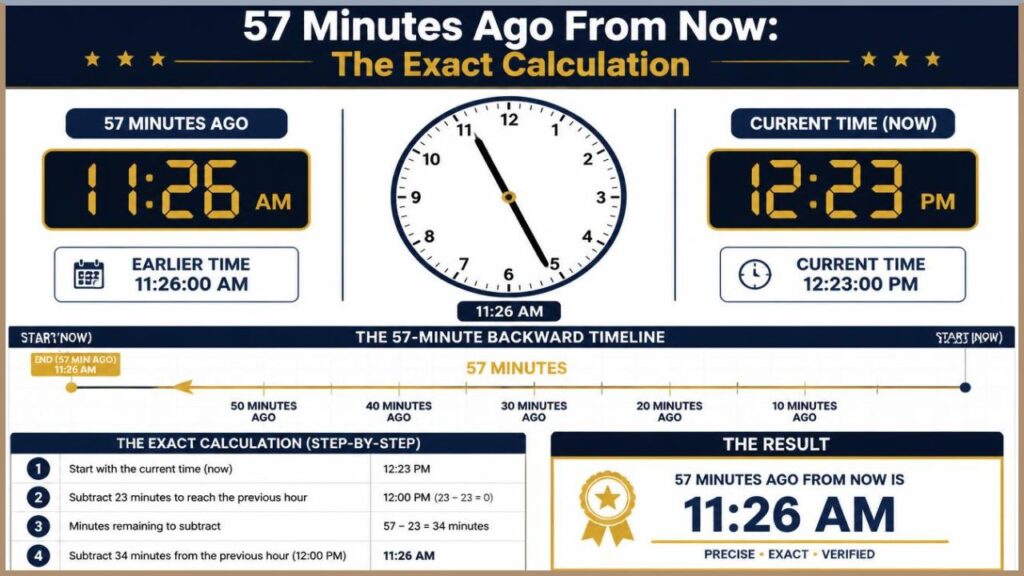
Using the reference time of 8:35:36 PM on October 24, 2026, we can calculate the previous time in a few simple steps.
Reference date. Saturday, October 24, 2026
Reference time
8:35:36 PM
Subtract this interval
− 00:57:00
Result: 57 minutes earlier
7:38:36 PM
Saturday, October 24, 2026
Notice that the result is earlier on the same calendar date. Since the calculation doesn’t cross midnight, there is no need to change the day, month, or year.
This distinction is useful whenever you are calculating the exact time of a past event rather than simply estimating it.
How to Calculate 57 Minutes Ago From the Current Time
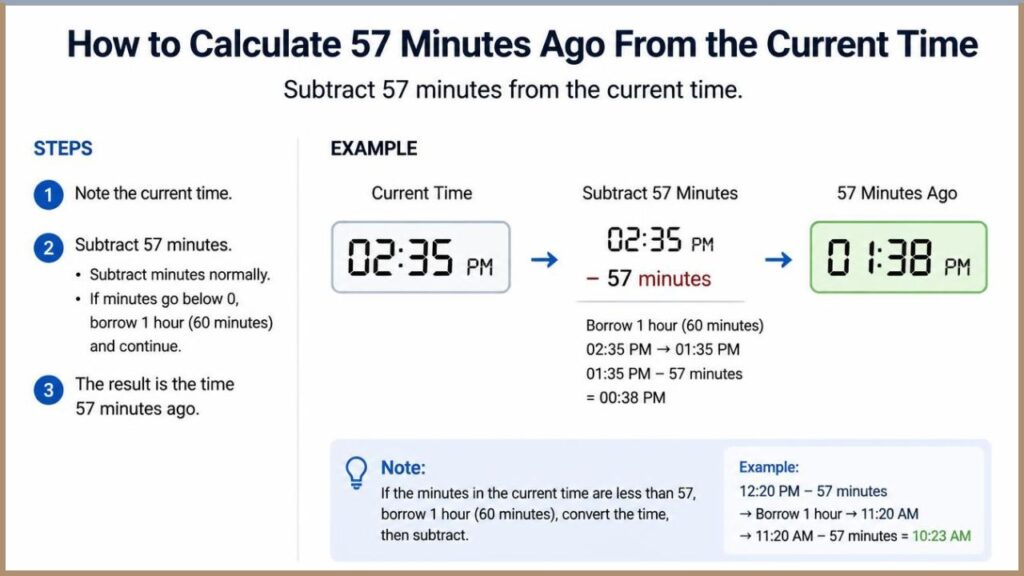
You can calculate a past time without using a calculator. The easiest approach is to subtract the minutes while keeping track of the hour.
Suppose the reference time is 8:35 PM.
- Start with the reference time: 8:35 PM.
- Subtract 35 minutes to reach 8:00 PM.
- You still need to subtract 22 minutes because 57 minus 35 equals 22.
- Subtract those remaining 22 minutes to reach 7:38 PM.
The final answer is 7:38 PM.
This method works because 57 minutes consists of 35 minutes plus another 22 minutes. Breaking the calculation into smaller steps makes it easier to follow, especially when mental arithmetic starts to feel a bit tangled.
You can also use a direct calculation:
The negative result tells you that the calculation must move into the previous hour. Converting the negative 22-minute result gives 38 minutes past 7 PM.
Both methods arrive at the same answer.
What Time Was It 57 Minutes Ago on October 24, 2026?

If you’re looking for a specific historical time, the answer depends on the reference clock time provided.
For Saturday, October 24, 2026, using 8:35:36 PM as the reference time, the result is 7:38:36 PM on that same Saturday.
The date remains unchanged because subtracting 57 minutes from 8:35:36 PM does not take us into the previous calendar day.
Here is a quick comparison of a few reference times and their corresponding results:
| Reference time | 57 minutes earlier |
|---|---|
| 8:35 PM | 7:38 PM |
| 9:00 AM | 8:03 AM |
| 12:30 PM | 11:33 AM |
| 3:10 PM | 2:13 PM |
| 11:45 PM | 10:48 PM |
| 12:20 AM | 11:23 PM on the previous day |
These examples illustrate why a past time calculation should always begin with a clearly identified reference time. The last example also shows that the calendar date can change when the calculation crosses midnight.
Using a 57 Minutes Ago Calculator
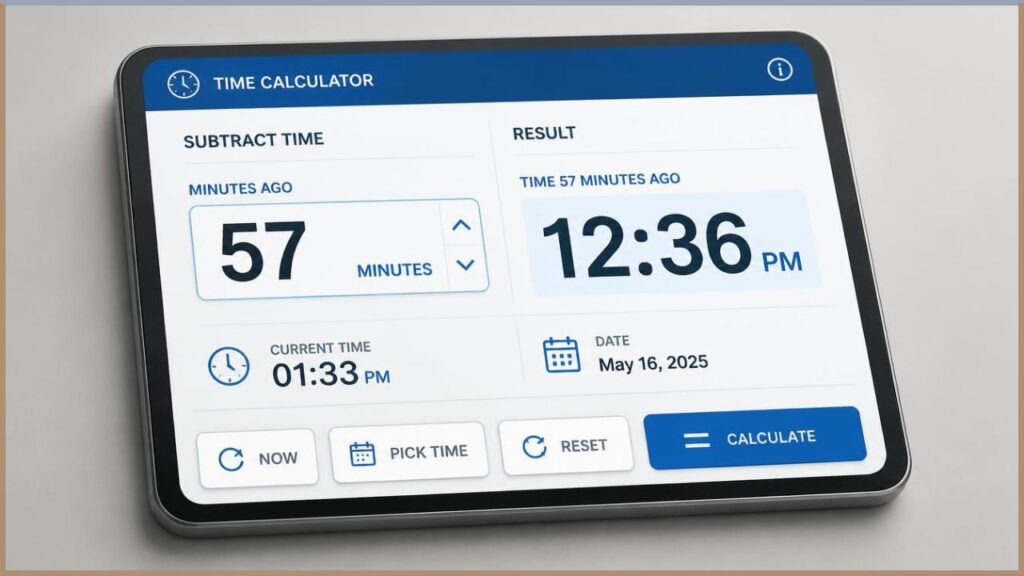
An online 57 minutes ago calculator is helpful when you need a quick answer without working through the arithmetic yourself. It is especially convenient if you’re calculating several time intervals or need a result that includes a date.
A typical time calculator lets you enter a reference date and time, choose whether to move forward or backward, and specify the number of minutes.
To calculate the time 57 minutes earlier:
- Enter the reference date, if the tool asks for one.
- Set the starting time to your chosen reference time.
- Select the backward calculation option, or choose subtraction.
- Enter 57 minutes as the interval.
- Click Calculate to view the resulting time and date.
Some tools also support seconds, hours, days, weeks, months, and years. That broader functionality makes a date calculator useful for more than simple minute subtraction.
For example, OTechWorld provides an online date and time calculation page at datetime.otechworld.com. You can explore the available functions there to see whether they fit your particular calculation.
Always check the time zone and reference time before relying on an online result. A calculator can perform the arithmetic correctly while still producing an answer that doesn’t match your intended local time if the starting information is wrong.
Why the Reference Time Matters
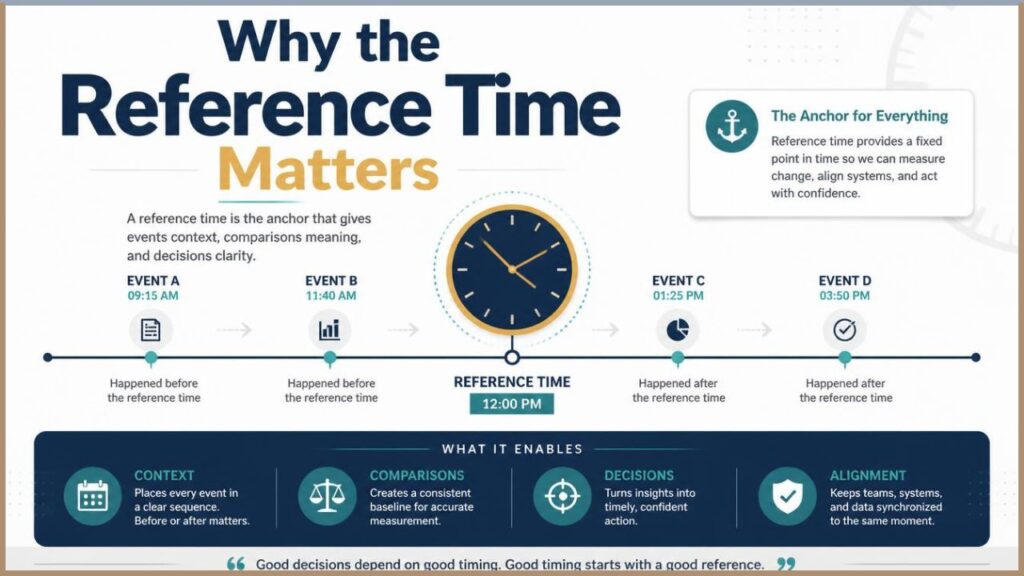
The phrase current time minus 57 minutes sounds straightforward, but it depends on what you mean by “now.”
A clock on your phone may display local time, while a website, server, or international meeting schedule may use another time zone. If the two clocks differ, the result can appear incorrect even when the subtraction itself is perfectly accurate.
For example, imagine that a person in Pakistan checks the time while a colleague in the United Kingdom records the same event. Their displayed clock times may differ because of their locations and seasonal time changes, but the actual interval between the two events remains the same.
For reliable calculations, keep these details in mind:
- Reference time: The exact clock time from which you are counting backward.
- Time zone: The location or time standard used for the reference.
- Date: The calendar date associated with the starting time.
- Time interval: The amount of time being subtracted.
- Seconds: Whether the calculation needs second-level precision.
These details become particularly important for digital records, appointments, delivery logs, and events recorded across different regions.
Calculating Past Times When the Hour Changes
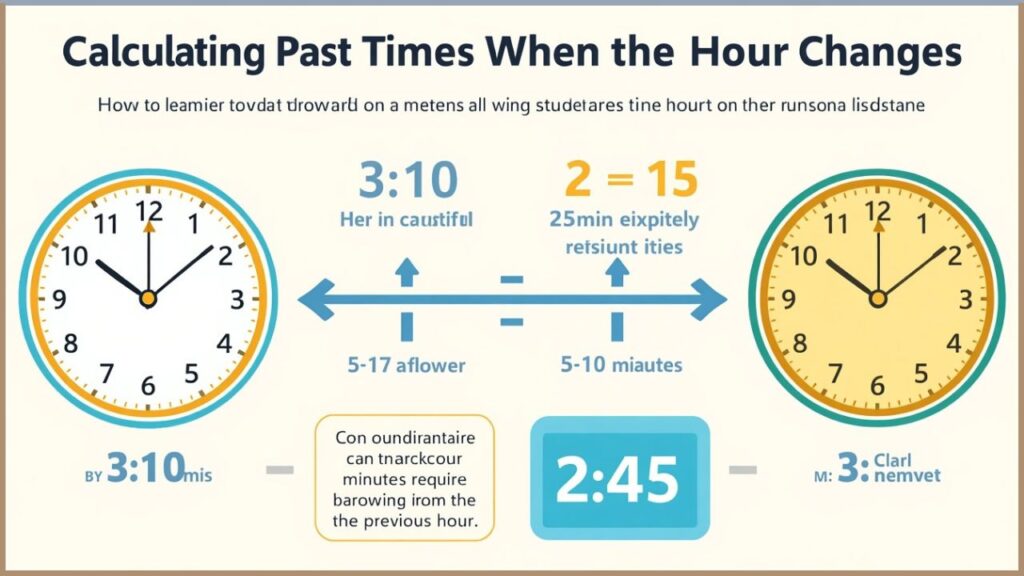
Subtracting 57 minutes is slightly more interesting when the reference time falls early in an hour. If the minutes displayed on the clock are fewer than 57, you’ll need to move into the previous hour.
Consider a reference time of 6:20 PM.
Since 20 minutes is less than 57 minutes, you cannot simply subtract 57 from 20 and keep the same hour. Instead, borrow one hour, which is equal to 60 minutes.
The calculation becomes:
\[ 6{:}20\text{ PM}-57\text{ minutes} =5{:}23\text{ PM} \]
You can verify this by moving backward 20 minutes to 6:00 PM, then another 37 minutes to 5:23 PM.
The same principle applies at any point on the clock. Once you understand how to borrow an hour, calculating previous times becomes much more manageable.
What Happens When 57 Minutes Ago Crosses Midnight?
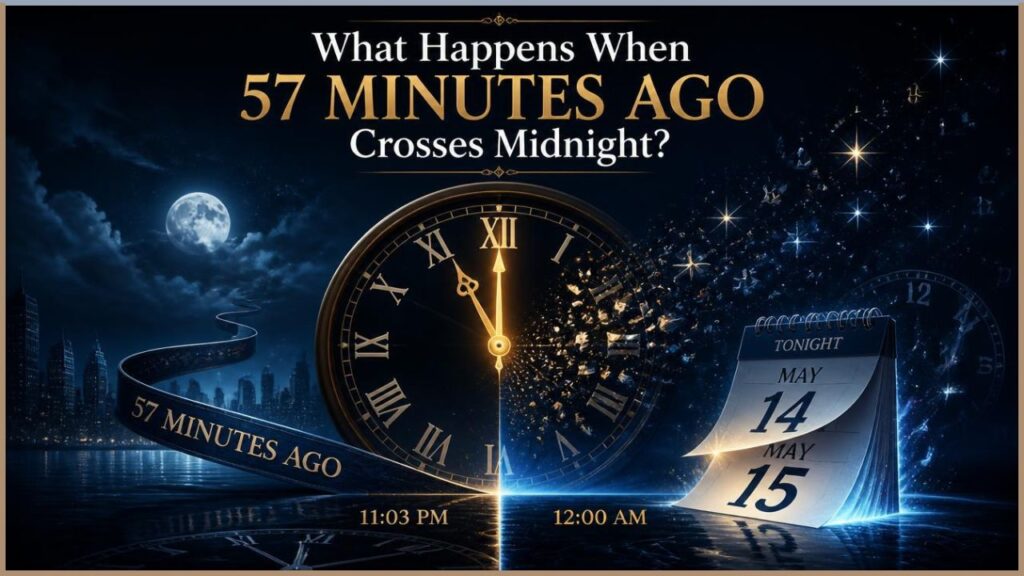
Crossing midnight introduces one extra detail: the calendar date may need to move backward by one day.
Imagine that your reference time is 12:25 AM on Sunday, October 25, 2026. Subtracting 57 minutes takes you to 11:28 PM on Saturday, October 24, 2026.
The arithmetic is:
\[ 12{:}25\text{ AM}-57\text{ minutes} =11{:}28\text{ PM} \]
The clock moves into the previous evening, and the date changes from Sunday to Saturday.
This is why a reliable date and time calculator should consider both the clock and the calendar. The time alone might look correct, but the date is equally important when documenting past events.
The reverse principle applies when adding minutes across midnight. If you calculate 57 minutes from 11:30 PM, the answer is 12:27 AM on the following day.
Related Time Calculations You May Need
Once you understand how to calculate 57 minutes ago, the same method can be used for many other intervals. A flexible time difference calculator can help with both past and future calculations.
| Calculation type | What it tells you |
|---|---|
| Minutes ago from now | A clock time a certain number of minutes in the past |
| Minutes from now | A future clock time |
| Hours ago from now | A previous time measured in hours |
| Hours from now | A future time measured in hours |
| Days ago from today | A calendar date in the past |
| Days from today | A future calendar date |
| Weeks ago from today | A date several weeks earlier |
| Weeks from today | A date several weeks ahead |
| Months ago from today | A previous calendar month and date |
| Months from today | A future calendar month and date |
| Years ago from today | A date in a previous year |
| Years from today | A date in a future year |
Minutes and hours are usually straightforward because their lengths are fixed. Months and years can be more complicated because months have different numbers of days and leap years affect February.
For this reason, use a calculator that understands calendar dates when working with larger time intervals rather than treating every month as an identical block of days.
Frequently Asked Questions About 57 Minutes Ago From Now
What time was it 57 minutes ago?
It depends on the reference time. If the clock shows 8:35 PM, then 57 minutes earlier was 7:38 PM. For the reference time 8:35:36 PM, the exact result is 7:38:36 PM.
How do I calculate 57 minutes before now?
Subtract 57 from the current minute count. If the result is negative, move back one hour and add 60 to the negative minute result. For instance, 20 minus 57 equals negative 37, which means you move to the previous hour and arrive at 23 minutes past it.
What is 57 minutes ago from 8:35:36 PM?
The answer is 7:38:36 PM. Subtracting 57 whole minutes changes the hour and minute values, but the seconds remain at 36.
Does subtracting 57 minutes change the date?
Not always. If the starting time is late enough in the day, the result remains on the same date. If the calculation crosses midnight, the result belongs to the previous calendar day.
Can I use an online calculator to find the exact time 57 minutes ago?
Yes. A minutes-ago calculator or a broader date and time calculator can perform the subtraction for you. Enter the correct reference time and date, select the backward direction, and specify 57 minutes.
What is the difference between 57 minutes ago and 57 minutes from now?
57 minutes ago means moving backward from the reference time. 57 minutes from now means moving forward. If the reference time is 8:35 PM, the past time is 7:38 PM, while the future time is 9:32 PM.
How accurate is a 57 minutes ago calculator?
The calculation is mathematically exact when the input time and interval are correct. However, the displayed result depends on the accuracy of the reference clock, the selected time zone, and whether the tool accounts for a date change.
Final Thoughts
Finding 57 minutes ago from now is a small calculation, but it becomes much easier when you understand the relationship between minutes, hours, and calendar dates. Whether you subtract the interval mentally or use an online calculator, the key is to begin with an accurate reference time.
Using the example of 8:35:36 PM on Saturday, October 24, 2026, we arrive at 7:38:36 PM on the same day. That single calculation demonstrates the basic principle: subtract the requested interval, adjust the hour when necessary, and check whether the date changes.
For quick calculations, keep the reference time clear and remember that every hour contains 60 minutes. For more complicated intervals involving days, weeks, months, or years, a date and time calculator can save effort and reduce mistakes.
Time moves forward whether we watch the clock or not, but understanding how to calculate it backward helps us make sense of the moments we’ve already passed.