Have you ever looked at a calendar, wondered how quickly time is moving, and tried to picture where you’ll be almost two years from now?
Maybe you’re planning a special occasion, setting a personal deadline, preparing for a family milestone, or simply curious about a date that seems far away but isn’t quite as distant as it sounds.
If today’s date is Monday, October 19, 2026, then 22 months from today will be Saturday, August 19, 2028. That’s the exact calendar date you get when you move forward by 22 calendar months while keeping the same day of the month.
It may seem like a simple calculation, but knowing your future date can make planning feel a whole lot easier. Instead of counting month by month on your fingers, you can use a date calculator or follow a straightforward calendar method to get the answer in seconds.
Whether you’re searching for the date 22 months from now, checking a future deadline, or learning how to calculate months ahead, this guide explains the result, the calculation behind it, and a few useful ways to work with future dates without getting lost in the calendar.
22 Months From Today: The Exact Date
The answer is straightforward: 22 months from today is Saturday, August 19, 2028, using October 19, 2026, as the reference date.
Here’s a quick breakdown of the calculation.
- Today’s date: Monday, October 19, 2026
- Time duration: 22 calendar months
- Future month: August
- Future year: 2028
- Exact future date: August 19, 2028
- Day of the week: Saturday
The calculation works by moving forward 12 months to October 19, 2027, and then adding another 10 months to reach August 19, 2028. Nothing complicated is hiding behind the numbers, which is rather nice when you just want a quick answer.
The important distinction is that calendar months are not all the same length. Some have 30 days, others have 31, and February is shorter. That’s why adding months is different from adding a fixed number of days.
What Date Will It Be 22 Months From Today?
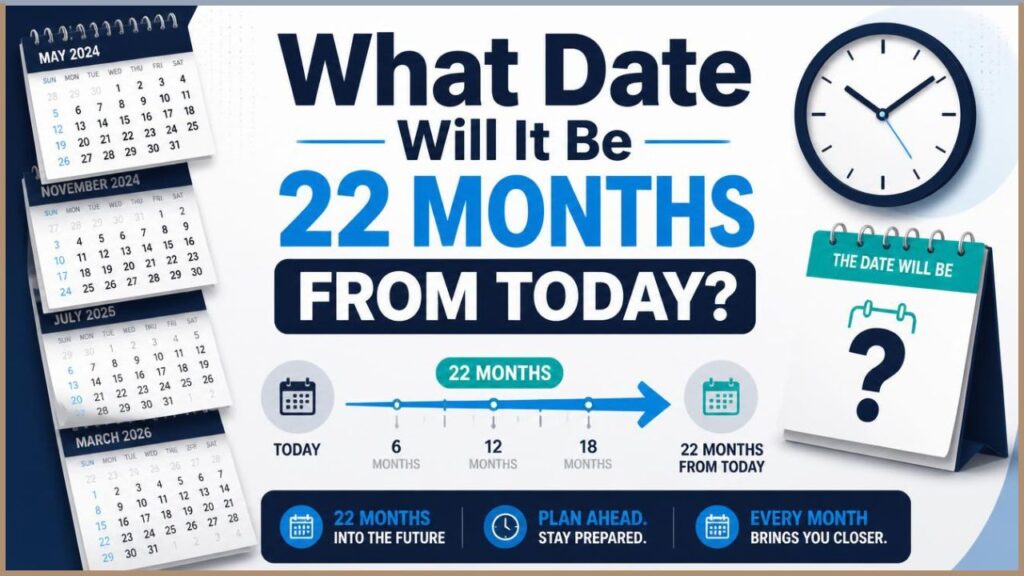
When people ask, “What date will it be 22 months from today?” they usually want a precise calendar answer, not an estimate based on weeks or days.
Starting with October 19, 2026, you move ahead one month at a time until you reach August 2028. Because the starting date is the 19th, and every destination month in this calculation contains a 19th, the day of the month remains unchanged.
Here’s how the months line up:
- October 19, 2026 — starting date
- November 19, 2026 — one month later
- December 19, 2026 — two months later
- January 19, 2027 — three months later
- April 19, 2027 — six months later
- October 19, 2027 — twelve months later
- April 19, 2028 — eighteen months later
- August 19, 2028 — twenty-two months later
You don’t have to write out every month to complete the calculation, of course. The list simply helps you see how the date progresses across the end of one year and into another.
The final result is Saturday, August 19, 2028. If you’re recording it in a planner, setting a reminder, or calculating a long-term milestone, that’s the date to use.
How to Calculate a Date 22 Months From Today
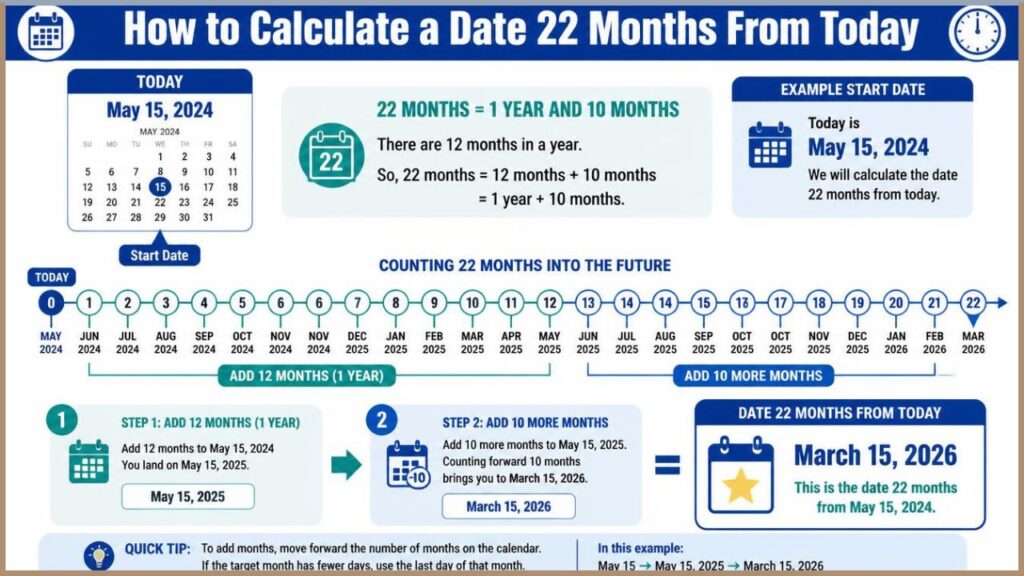
You can calculate a future date without a special app. A little calendar arithmetic does the job, and once you understand the method, it becomes much easier to calculate other intervals too.
Start With Today’s Date
The first step is identifying the reference date. For this example, today’s date is October 19, 2026.
A calculation is only as reliable as its starting point. If you’re reading this article on another day, use your actual current date rather than automatically assuming the reference date is still October 19, 2026.
Convert Months Into Years and Remaining Months
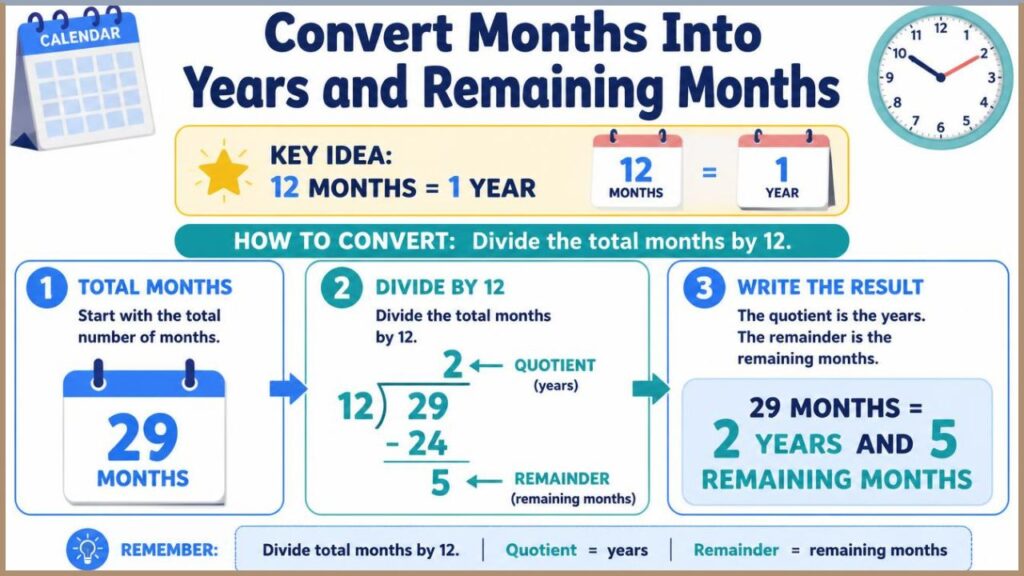
Twenty-two months consists of one full year and ten additional months.
- 12 months = one year
- 22 months = one year and ten months
Add one year to October 19, 2026, and you get October 19, 2027. Then add ten months, which brings you to August 19, 2028.
This approach is especially useful when you need to calculate several months ahead. Instead of moving through every single month, you can break the duration into manageable parts.
Check the Destination Date
Once you’ve reached August 19, 2028, verify the weekday if that information matters to your plans. The date falls on a Saturday.
A day of the week calculator can help confirm the weekday for a future calendar date. This is useful for appointments, trips, events, and other plans where the day matters as much as the date itself.
Add 22 Months to Today’s Date Using a Date Calculator
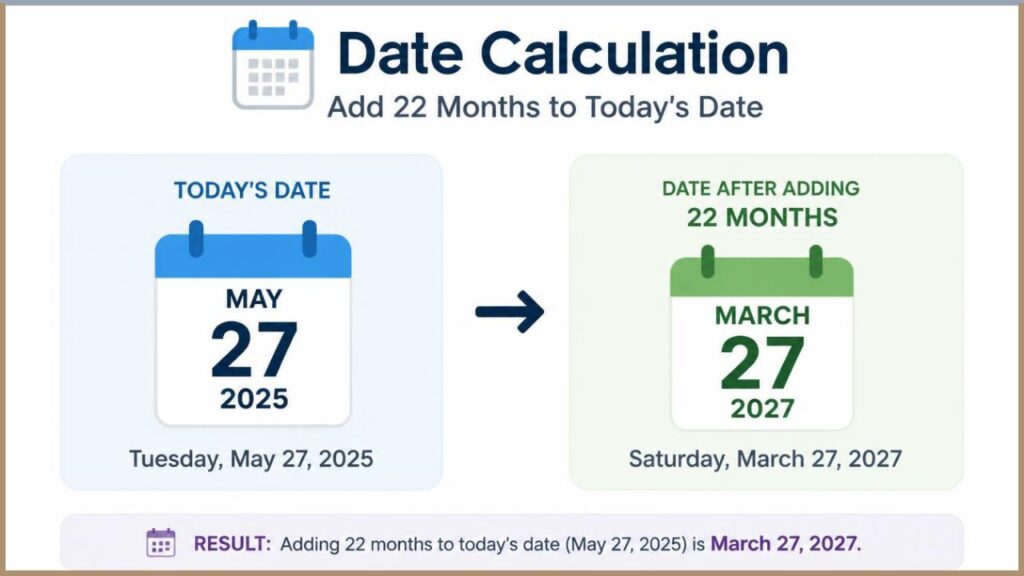
If you prefer a quicker method, an online future date calculator can perform the calculation for you. These tools are handy when you’re working with unfamiliar dates, planning several milestones, or trying to avoid a small arithmetic mistake.
A typical calendar date calculator works in a few simple steps.
- Enter the starting date, October 19, 2026.
- Select the option to add time to a date.
- Enter 22 in the months field.
- Calculate the result.
- Check the displayed future date and weekday.
You should receive August 19, 2028, as the result.
An online months from today calculator is particularly convenient when you need to repeat this process for different intervals. For example, you might calculate six months ahead for a review, 14 months ahead for a project, and 22 months ahead for a longer-term goal.
Websites such as datetime.otechworld.com may be useful starting points for date and time calculations. When using any online calculator, make sure you’ve selected months rather than days, because the two units produce different results.
For anything legally or financially significant, double-check the result against the rules that apply to your specific deadline. A calendar calculation doesn’t automatically account for business days, public holidays, or special contractual terms.
What Day Will It Be in 22 Months?
Knowing the future weekday can be surprisingly helpful. A date that looks convenient on paper may fall on a weekend, while a date that seems distant could turn out to be ideal for a family gathering or personal event.
In this example, 22 months from now falls on Saturday, August 19, 2028.
Saturday is often convenient for occasions that involve family members, friends, or people who work during the week. If you’re organizing a celebration, the date might be a useful starting point, although availability and local circumstances should always be checked closer to the time.
To confirm the weekday independently, use a reliable calendar or a day of the week calculator. You can also consult a printed calendar for August 2028.
Remember that the weekday is attached to the specific date, not simply to the number of months you’ve added. If you change the reference date, the future weekday may change as well.
Why 22 Months Is Different From 22 Weeks or 22 Days
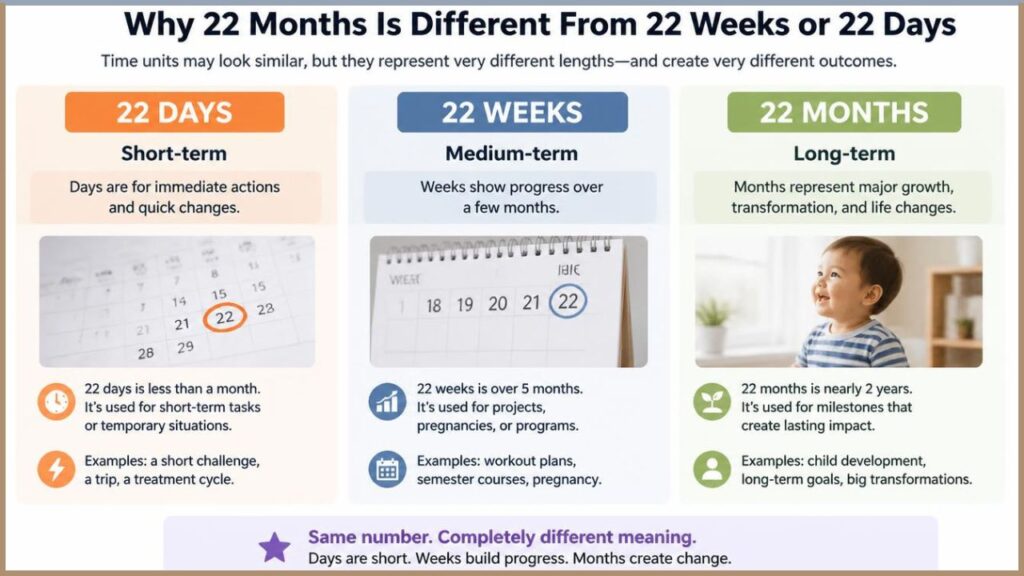
One common source of confusion is treating months as though they were fixed blocks of time. They aren’t, and that little detail can make a real difference in planning.
Twenty-two days, 22 weeks, and 22 months are three entirely different durations.
- 22 days from today means moving forward by exactly 22 calendar days.
- 22 weeks from today means moving forward by 154 days.
- 22 months from today means moving forward by 22 calendar months.
Starting from October 19, 2026, these calculations will not lead to the same date. The month-based calculation ends on August 19, 2028, while the day-based calculations depend on the precise number of days added.
This distinction matters when you’re planning deadlines, reviewing agreements, estimating project timelines, or counting down to an important occasion.
If someone tells you to return in 22 months, for instance, you shouldn’t automatically interpret that instruction as a particular number of days. Calendar months are the more natural unit when the original instruction is expressed in months.
Other Useful Date and Time Calculations
Once you know how to calculate a future date, it’s easy to explore other intervals. The same basic idea can help you plan short-term tasks as well as events that are still a long way off.
Calculate Days From Today
A days from today calculator is useful when you need an exact number of calendar days between now and a deadline. Unlike months, days have a consistent length as units of calendar counting, although the actual elapsed hours can vary across daylight-saving transitions in some locations.
You might use it to count down to a birthday, a submission date, or the beginning of a holiday.
Calculate Weeks From Today
A weeks from today calculator is useful for routines and schedules that repeat in seven-day intervals. It can help with training plans, project check-ins, study schedules, or regular appointments.
Twenty-two weeks is 154 days, which makes it a different calculation from moving ahead 22 calendar months.
Calculate Years From Today
A years from today calculator can help when you’re planning long-term commitments. You might use it to estimate a future anniversary, review a savings goal, or identify a date several years into the future.
When adding years, pay attention to February 29 if the starting date falls on a leap day. Different tools and applications may apply different conventions when the corresponding date doesn’t exist in the destination year.
Calculate Minutes or Hours From Now
A minutes from now calculator or hours from now calculator is more appropriate for short intervals. These tools are useful for reminders, cooking times, meetings, and everyday scheduling.
For such calculations, the time of day and the relevant time zone may matter. If you need an exact elapsed-time result, be sure to distinguish between calendar time and the actual number of minutes or hours that pass.
Understanding the Difference Between Future and Past Dates
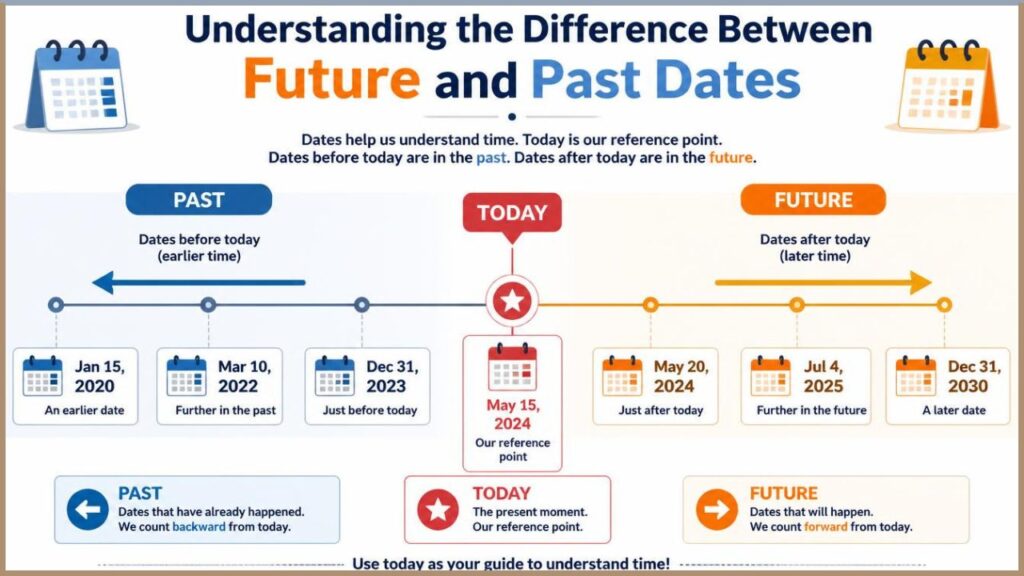
Future calculations are only one part of working with dates. Sometimes you need to find out how far in the past a particular date occurred.
For example, a months ago from today calculator can help you work backward from October 19, 2026, to identify the date 22 calendar months earlier.
Moving backward by 22 calendar months from October 19, 2026, leads to December 19, 2024.
This is different from subtracting a fixed number of days. The result depends on calendar months and the conventions used by the calculator, particularly when a starting date falls near the end of a month.
A date difference calculator can be useful when you need to compare two dates rather than simply add or subtract an interval. Depending on the tool, it may display the difference in years, months, weeks, or days.
The key is to select the calculation that matches your question. Adding months, counting elapsed days, and finding a difference between dates are related tasks, but they aren’t interchangeable.
Common Mistakes When Calculating 22 Months From Today
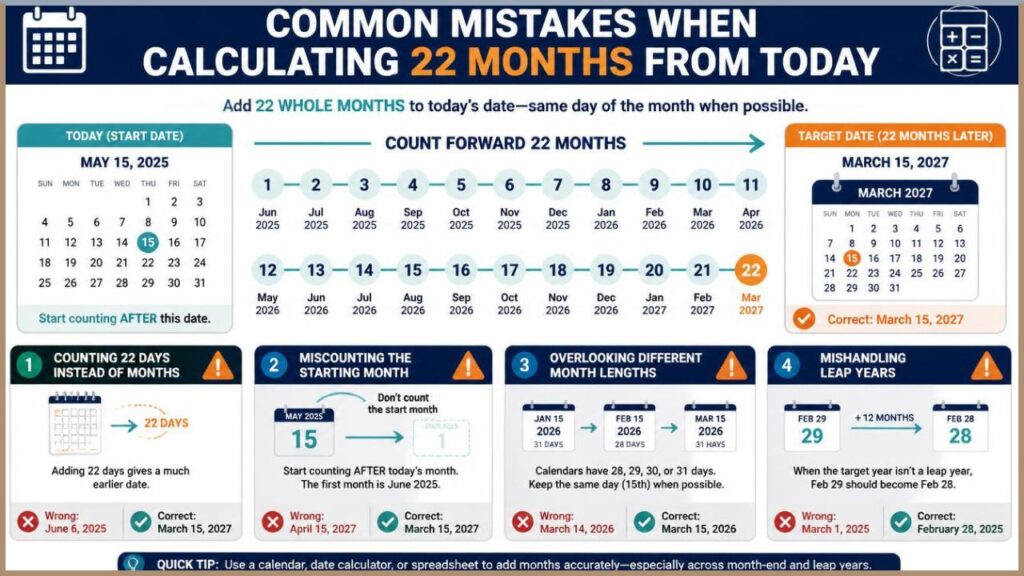
Even a simple calculation can go wrong if the units or starting date aren’t clear. Fortunately, most mistakes are easy to avoid.
Confusing Months With Days
The most common mistake is converting 22 months into an approximate number of days and then adding that number to the starting date. Because months vary in length, this approach won’t reliably produce the same calendar date.
For an exact calendar-month calculation, add 22 months rather than estimating the number of days.
Forgetting to Check the Reference Date
The phrase “today” changes meaning as time passes. An article written with October 19, 2026, as its reference date will not always display the correct result for someone reading it later.
If the reference date is October 19, 2026, the correct result is August 19, 2028. If today’s date is different, repeat the calculation using the current date.
Overlooking the Weekday
Some people only record the month and day, then discover later that the date falls on an inconvenient weekday. Checking the weekday early can help you make more realistic plans.
For this calculation, the destination is Saturday, which may suit many personal occasions but could be less convenient for certain professional or administrative deadlines.
Assuming Every Date Can Be Carried Forward Unchanged
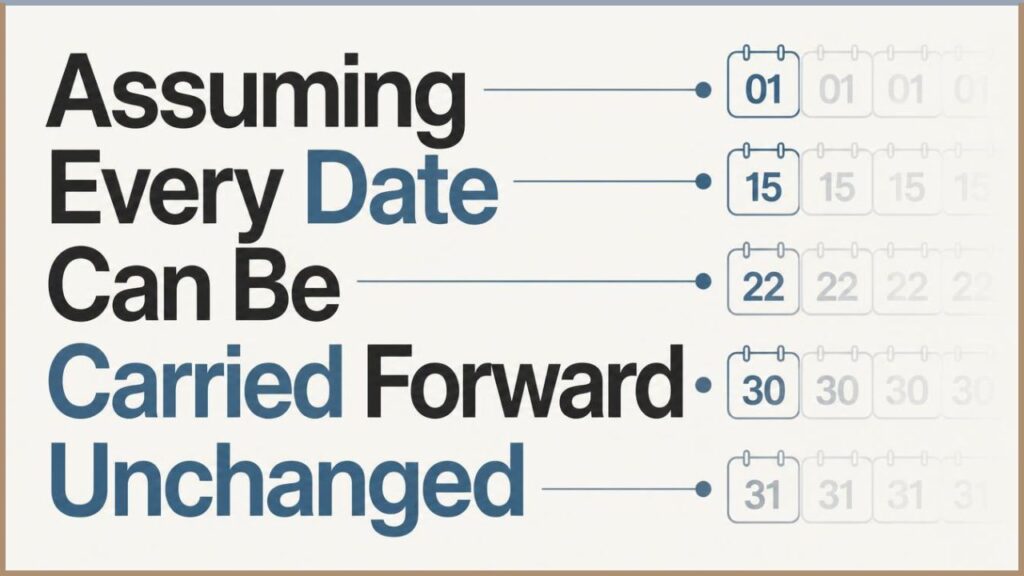
The 19th exists in every month, so this example is uncomplicated. Other dates can be trickier.
If you add one month to January 31, for example, February doesn’t have a 31st. Different calendar systems and applications may move the result to the last day of February or apply another documented rule.
When a deadline depends on this kind of calculation, check the calculator’s convention rather than assuming every tool handles the situation identically.
Practical Reasons to Calculate 22 Months Ahead
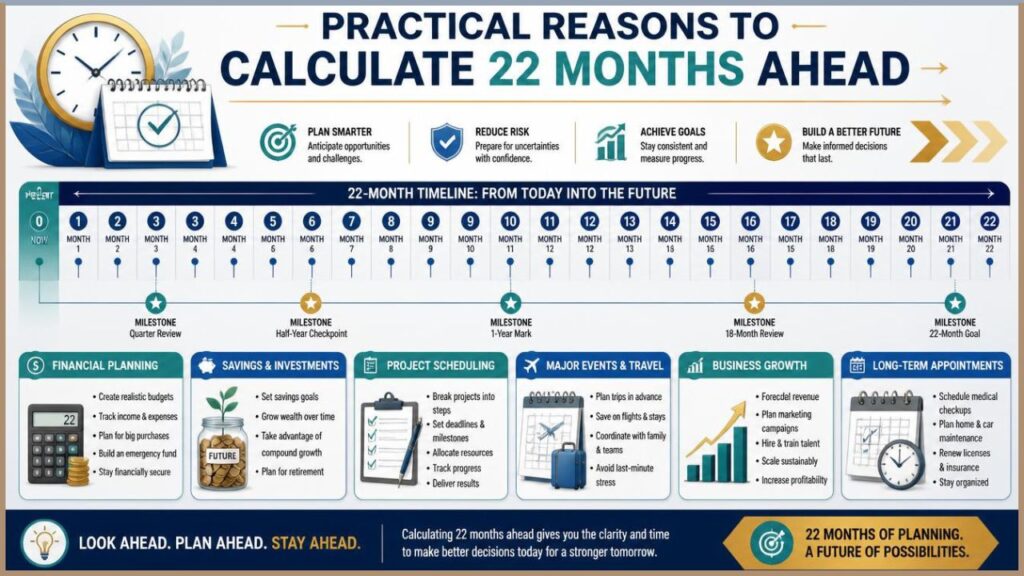
A date nearly two years away may feel abstract, but there are plenty of everyday reasons to calculate it accurately.
You might be planning a major personal project, setting a long-term savings target, arranging a future trip, or working toward an educational or professional milestone. Identifying the destination date gives you something concrete to work with.
For example, someone starting a 22-month project on October 19, 2026, could mark August 19, 2028, as the intended completion date. They could then break the project into smaller stages, with monthly reviews and intermediate deadlines.
The same approach works for personal goals. Rather than thinking vaguely about something you hope to accomplish “in a couple of years,” you can establish a calendar date and plan backward from it.
That doesn’t mean every future plan must be rigid. Life changes, schedules shift, and unexpected things happen. A future date is simply a useful reference point, not a promise that everything will unfold exactly as expected.
Frequently Asked Questions About 22 Months From Today
What is the exact date 22 months from October 19, 2026?
The exact date is August 19, 2028. Adding 22 calendar months to October 19, 2026, takes you to that date.
What day of the week will it be in 22 months?
It will be Saturday, August 19, 2028. You can verify the weekday using a calendar or a reliable date calculator.
How do I add 22 months to today’s date?
Break 22 months into one year and ten months. Add one year to October 19, 2026, to get October 19, 2027, and then add ten more months to reach August 19, 2028.
Is 22 months the same as two years?
No. Two years is 24 calendar months, while 22 months is two months shorter. From October 19, 2026, two years later would be October 19, 2028, whereas 22 months later is August 19, 2028.
Can an online date calculator find the result automatically?
Yes. Enter the reference date, select the option to add months, and enter 22. Check that the calculator displays the expected calendar date and, if needed, the correct weekday.
Does the result change if I use a different starting date?
Yes. The destination date depends on the starting date and the number of months added. If you are calculating 22 months from a date other than October 19, 2026, you should use that date as the reference point.
Is August 19, 2028, a reliable date for planning a deadline?
It is the correct calendar result for adding 22 months to October 19, 2026. However, official deadlines may follow special rules involving business days, holidays, time zones, or contractual definitions. Check those rules before relying on the date for a formal obligation.
Final Thoughts: Make Future Dates Easier to Manage

Calculating a date in the future doesn’t have to involve complicated arithmetic or endless calendar scrolling. When you know the starting point and understand the difference between calendar months and days, the answer becomes much easier to find.
For this example, 22 months from today is Saturday, August 19, 2028, based on the reference date of Monday, October 19, 2026. You can reach the same result by adding one year and ten months, or by using an online future date calculator.
The most useful habit is to record the reference date, state the interval clearly, and double-check the result whenever a deadline or important commitment depends on it. A few seconds of careful calculation can save you from confusion later.
Whether you’re planning a project, preparing for a milestone, or simply curious about what lies ahead, having a clear date gives your plans a place to begin. The calendar may keep moving, but with the right tools and a little attention to detail, you can move forward with greater confidence, one date at a time.