There is something strangely comforting about knowing exactly where a moment went. We usually let minutes disappear without noticing them, but every once in a while we need to look backward and ask a very ordinary question: what time was it 23 minutes ago?
Maybe you are checking when a message was sent, figuring out when an online meeting actually started, remembering when you took a screenshot, or simply satisfying that little itch of curiosity that clocks sometimes create. Time is quiet like that, it slips away without making much noise.
At first glance, 23 minutes ago from now sounds almost too simple to deserve an explanation. And honestly, the calculation is simple.
But the interesting part is understanding what “now” actually means, how the calculation changes when the minutes cross an hour or even a date, and why a time calculator can sometimes be more useful than doing the arithmetic in your head.
A tiny difference in time can matter more than we expect, specially when the event involves deadlines, appointments, messages, travel, or records.
This guide explores the meaning of 23 minutes ago, shows the exact calculation using a stated reference time, and also looks at the reverse idea of 23 minutes from now.
Along the way, we will touch on elapsed time, relative dates, time subtraction, and the surprisingly useful world of date and time calculation. No giant clock-wizardry is needed here, just a clear reference point and a little attention.
| Reference Time | Subtract | Time 23 Minutes Ago |
|---|---|---|
| 10:02 PM | 23 minutes | 9:39 PM |
| 8:00 PM | 23 minutes | 7:37 PM |
| 5:30 PM | 23 minutes | 5:07 PM |
| 3:10 PM | 23 minutes | 2:47 PM |
What Does 23 Minutes Ago From Now Mean?
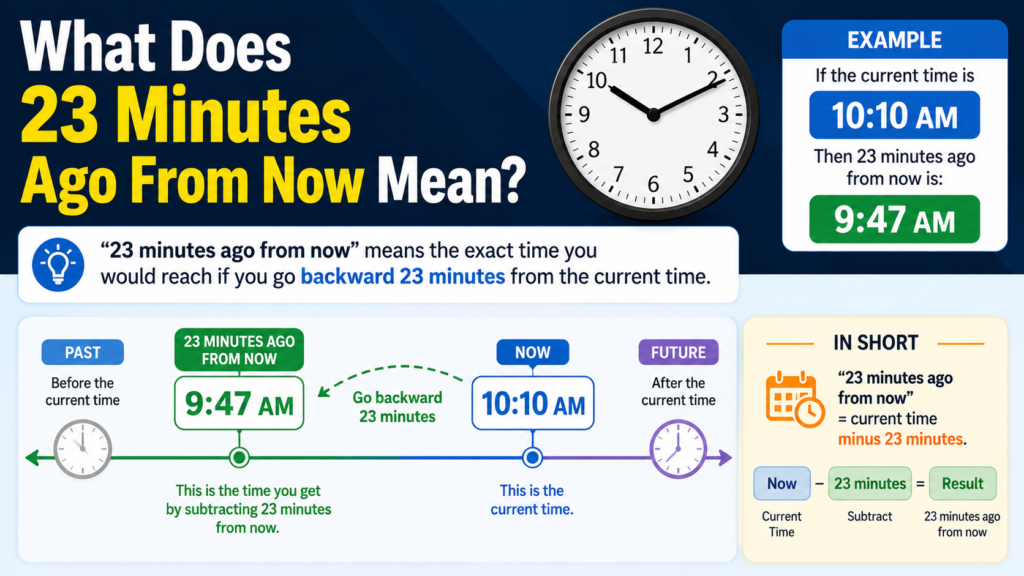
The phrase 23 minutes ago from now describes a point in the past that is exactly 23 minutes earlier than the current reference time.
The key word is “now.” Without a reference point, the answer cannot be fixed, because the clock keeps moving every second. A result that is correct at 10:02 PM becomes different at 10:03 PM, which is rather obvious but easy to forget.
In simple terms, the relationship is:
Current time → subtract 23 minutes → previous time
So if the reference time is 10:02:04 PM, and we subtract 23 minutes, the result is 9:39:04 PM. The seconds stay unchanged because we are subtracting a whole number of minutes. That gives us a clean 23-minute time difference.
This is also why a phrase like “23 minutes ago” is called a form of relative time. It does not describe a permanent clock time by itself. Instead, it describes a position relative to another moment.
If somebody says, “I called you 23 minutes ago,” their statement is attached to the moment when they say it, not to some eternal point on the clock.
What Time Was It 23 Minutes Ago?
Using the reference values provided for this example, the stated current/reference time is 10:02:04 PM on Wednesday, August 12, 2026.
Now we perform the time subtraction:
10:02:04 PM − 23 minutes = 9:39:04 PM
Therefore, 23 minutes ago from the stated reference time, it was 9:39:04 PM on Wednesday, August 12, 2026.
The calculation is small, but it demonstrates an important rule in time arithmetic. You are not changing the seconds, and you are not changing the date because the subtraction remains inside the same hour and calendar day.
Had the reference been 12:10 AM, however, subtracting 23 minutes would have pushed the result into the previous calendar date. Thats where a basic mental calculation can suddenly become a little less friendly.
It is worth making one clarification: 10:02:04 PM and 9:39:04 PM are reference values used in this example, not a claim about the live current time at the moment you read this article. A true “now” calculation changes continuously, so a live current time tool must use the actual clock at the instant of calculation.
How to Calculate 23 Minutes Ago
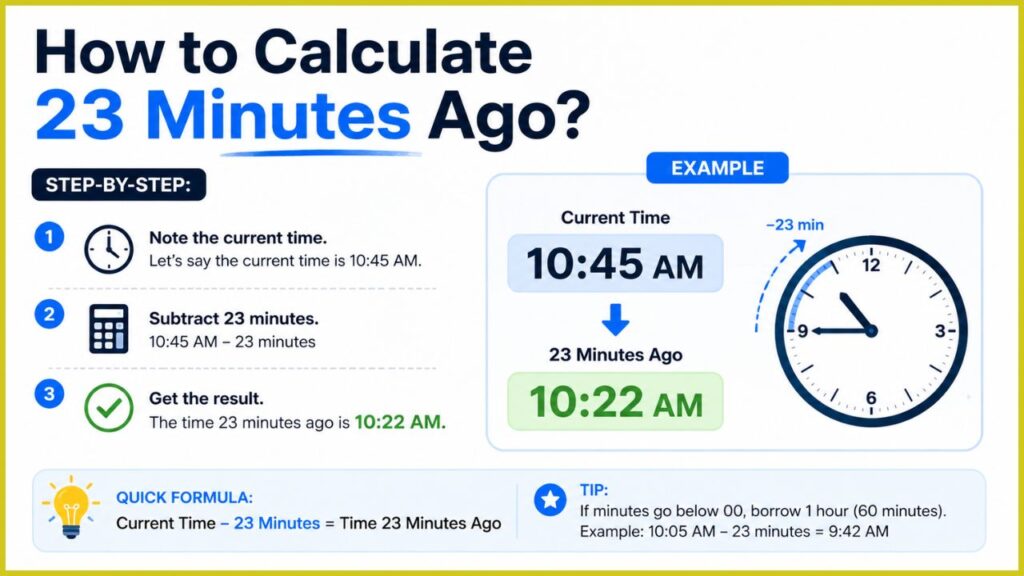
You do not need a complicated date and time calculator to solve a 23-minute subtraction when the times are straightforward. The basic process is almost charmingly old-fashioned: look at the clock, take away 23 minutes, and check whether the result crosses an hour or date boundary.
Suppose your clock says 8:50 PM. Subtracting 23 minutes gives 8:27 PM. Nothing dramatic happens because both times belong to the same hour.
Now imagine the clock says 8:10 PM. Subtracting 23 minutes gives 7:47 PM. Here, the calculation moves into the previous hour. You can think of it as subtracting 10 minutes to reach 8:00 PM, then subtracting the remaining 13 minutes to reach 7:47 PM.
For the specific example in this article:
- Reference time: 10:02:04 PM
- Duration to subtract: 23 minutes
- Hour boundary crossed: No
- Date boundary crossed: No
- Result: 9:39:04 PM
That is the entire backward time calculation. The trick is simply to notice whether the subtraction crosses an hour, midnight, or another calendar boundary. People usually make mistakes not because 23 is difficult, but because clocks have those annoying little boundaries where everything changes at once.
Why the Exact Time Matters

A rough answer such as “around 9:40 PM” may be enough when you are remembering when a friend called. But sometimes you need the exact time. A work log, payment record, security event, online transaction, appointment, or message history can depend on minutes and seconds rather more than we might like.
For example, suppose someone says a meeting began 23 minutes before a recorded event at 10:02:04 PM. The precise result is 9:39:04 PM. If the event itself occurred at 9:39:07 PM, then only three seconds separate the two moments. A vague answer could hide that relationship completely.
This is where elapsed time becomes useful. Elapsed time asks how much time passed between two points, while “23 minutes ago” asks for the earlier point based on a later reference. They are related, but they are not exactly the same question.
A time difference calculator handles these relationships especially well because it can compare timestamps rather than simply subtracting a number of minutes. It becomes particularly helpful when hours, dates, or time zones enter the picture.
23 Minutes From Now: Looking Into the Future
The reverse of 23 minutes ago is 23 minutes from now. Instead of subtracting 23 minutes, you add them.
If the reference time is 10:02:04 PM, then:
10:02:04 PM + 23 minutes = 10:25:04 PM
So, from that stated reference point, 23 minutes from now would be 10:25:04 PM. The seconds again remain unchanged because the duration being added is exactly 23 minutes.
This simple reversal is useful in everyday situations. If your food delivery is expected in 23 minutes, if a presentation begins in 23 minutes, or if you need to leave home 23 minutes from now, you are performing the same kind of time calculation, just in the future direction.
The words “ago” and “from now” therefore act almost like tiny mathematical instructions. Ago generally means move backward, while from now means move forward. Once you see it that way, relative time becomes less mysterious.
23 Minutes Ago From Now Across Midnight
The calculation becomes more interesting when 23 minutes takes you across midnight. Consider a reference time of 12:10 AM.
Subtract 10 minutes and you reach 12:00 AM. There are still 13 minutes left to subtract, so you move backward into the previous day. The final result is 11:47 PM on the previous calendar date.
This is where the date calculator side of time calculation becomes important. You are no longer dealing with only hours and minutes; the date has changed too.
The same principle works with a larger interval. If you needed to calculate 23 hours ago from now, the date could change even though the clock arithmetic remains relatively simple.
With 23 days ago from today, the calendar date changes substantially, and with 23 weeks ago from today, you are moving backward by 161 days.
Time units can look innocent until they start pushing the calendar around. Minutes are the polite ones, most of the time.
23 Minutes Ago, 23 Hours Ago, and 23 Days Ago
The number 23 can describe very different journeys depending on its unit.
23 minutes ago means 23 minutes into the past. 23 hours ago from now means almost one full day backward, while 23 days ago from today takes you several weeks into the past. The same number remains fixed, but the temporal distance changes dramatically.
You can extend the idea further:
- 23 minutes ago a very recent past time.
- 23 hours ago from now roughly a day earlier.
- 23 days ago from today more than three weeks earlier.
- 23 weeks ago from today roughly five and a half months earlier.
- 23 months ago from today almost two years earlier.
- 23 years ago from today a completely different era of your life for many people.
Likewise, 23 minutes from now, 23 hours from now, 23 days from today, 23 weeks from today, 23 months from today, and 23 years from today all describe future points at different scales.
This is why a proper time conversion or date-time tool needs to know not just the number but also the temporal unit. “23” alone does not tell us very much. Twenty-three what? Minutes, hours, days, or years? Time is picky about its nouns.
When a Time Calculator Is Better Than Mental Math
For a simple 23 minutes ago calculation, your brain is more than capable. But a time calculator becomes useful when the calculation includes several moving pieces.
Perhaps you need to subtract 47 minutes from 1:12 AM, compare two dates, calculate elapsed time between appointments, or account for a time-zone difference.
A good date and time calculator can reduce small errors that become surprisingly troublesome. It may account for hours, minutes, seconds, calendar dates, and sometimes time zones or daylight-saving changes. These details matter when the interval is longer than a few minutes.
A calculator is especially handy when you are working with:
- Time subtraction across an hour or midnight.
- Elapsed minutes between two timestamps.
- A previous date caused by crossing midnight.
- A long time interval involving hours or days.
- A time offset between locations.
- Exact date and time records.
- Repeated past time calculation for logs or schedules.
There is no prize for doing complicated temporal arithmetic in your head, honestly. If a tool can do it accurately, let the tool carry the tiny burden.
Understanding “Minutes Ago From Now”
The phrase minutes ago from now is a relative expression, and it is common in digital life. Social platforms, messaging applications, news feeds, and notification systems often show events as “5 minutes ago,” “23 minutes ago,” or “2 hours ago.”
These labels are convenient because people understand them quickly. Seeing “23 minutes ago” immediately tells you that something happened recently, without forcing you to read an exact timestamp. But relative labels can become ambiguous if the reference time is unknown.
Suppose you see a screenshot showing “23 minutes ago.” If you do not know when the screenshot was taken, you cannot reliably reconstruct the exact clock time. You need the reference point.
That is the central rule of relative date and time:
Past or future time is always relative to something.
Once the reference point is known, the calculation becomes straightforward. Without it, even perfect arithmetic cannot produce a trustworthy answer. Numbers are obedient; they just need somebody to tell them what they are standing next to.
A Quick Method for Calculating 23 Minutes Before Now
If you want to calculate 23 minutes ago from the current time manually, use this small method.
First, identify the exact current time, including the date if precision matters. Then subtract 23 from the minute value. If the minute value is at least 23, you can usually subtract directly. If it is less than 23, borrow one hour, turn that hour into 60 minutes, and continue the subtraction.
For example, if the time is 6:15 PM:
60 + 15 = 75 minutes for the borrowed hour representation.
75 − 23 = 52 minutes.
Because you borrowed an hour, the hour changes from 6 to 5. Therefore, the answer is 5:52 PM.
This is basic time arithmetic, but writing the borrowing step down can prevent silly errors. When you’re tired, even a clock can suddenly feel like it was designed by a committee.
What If You Need the Exact Date Too?
When the calculation remains within the same day, the date does not change. In the example given here, Wednesday, August 12, 2026, at 10:02:04 PM becomes 9:39:04 PM after subtracting 23 minutes. The date remains Wednesday, August 12, 2026.
But if the reference time were shortly after midnight, the previous date would need to be calculated too. This is where a date time calculator can save time, especially when you are working backward across several days.
For larger questions such as “How many days ago from today was a particular event?” you are no longer doing only clock arithmetic. You are doing calendar arithmetic. Months have different lengths, leap years exist, and dates can cross into another year.
A question that starts as “what time was it 23 minutes ago?” can therefore open a surprisingly large door into how humans measure time. Tiny question, enormous calendar hiding behind it.
Why People Search for “What Time Was It 23 Minutes Ago?”
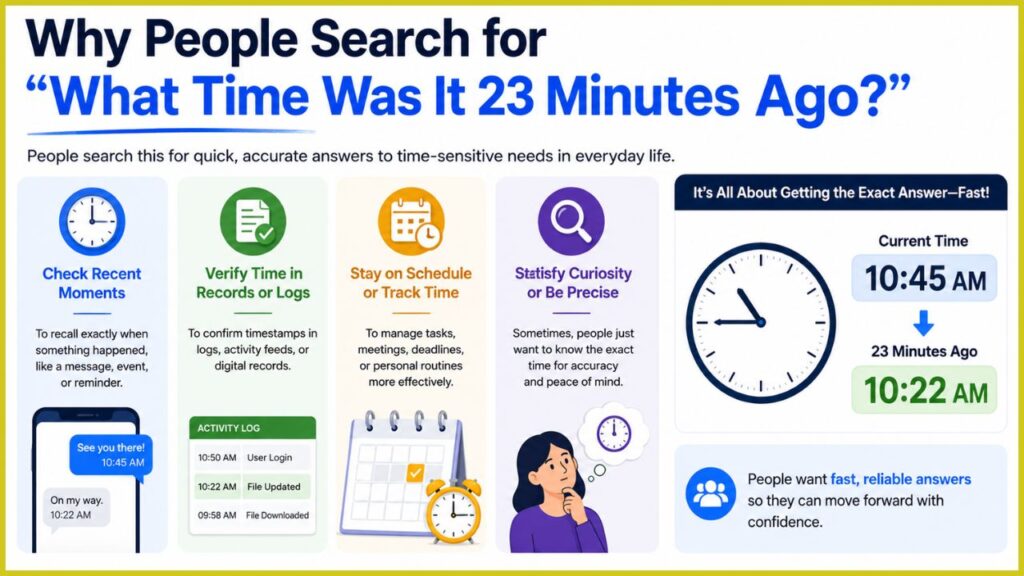
The search intent behind what time was it 23 minutes ago is usually very practical. Someone may have seen a timestamp, noticed a notification, missed a call, or needs to verify an event. Other people are simply looking for a quick answer without doing the subtraction themselves.
Searches such as 23 minutes ago time calculator, subtract 23 minutes, time subtraction calculator, and calculate time ago all belong to the same general intent. The person has a reference time and wants the corresponding earlier time.
There is also a related future intent: 23 minutes from now. In that case, the user is not reconstructing the past but planning the immediate future. The mathematics is nearly identical, only the direction changes.
This makes relative-time tools useful in both directions: backward for records and memory, forward for planning and scheduling.
Common Mistakes in a 23-Minute Calculation
The first common mistake is forgetting the reference time. Saying “23 minutes ago” without knowing when “now” was recorded makes an exact answer impossible.
Another mistake is subtracting 23 from the hour instead of the minutes. If the clock says 10:02 PM, you do not calculate 10 − 23. You work with the minutes, borrowing an hour when necessary.
People also sometimes forget the date when crossing midnight. A result of 11:47 PM is not enough if you need a full timestamp; you must know which day that 11:47 PM belongs to.
Time zones can create another layer of confusion. If someone in one country says an event happened 23 minutes ago and another person checks it from a different location, the displayed local times may differ even though the actual moment is identical.
Finally, don’t confuse elapsed time with clock time. Twenty-three minutes is a duration. 9:39:04 PM is a clock time. One tells you how long; the other tells you when. They work together, but they aren’t interchangeable.
A Compact Reference Table
| Question | Meaning |
|---|---|
| 23 minutes ago | 23 minutes before the reference time |
| 23 minutes from now | 23 minutes after the reference time |
| 23 hours ago from now | 23 hours before the reference time |
| 23 days ago from today | 23 calendar days before today |
| 23 weeks ago from today | 23 weeks before today |
| 23 months ago from today | 23 calendar months before today |
| 23 years ago from today | 23 years before today |
| 23 minutes before now | Same calculation as 23 minutes ago |
| 23 minutes in the past | Another way to describe the earlier point |
| 23-minute time difference | A duration of exactly 23 minutes |
The table looks almost too neat for something as messy as time, but thats the charm of measurement: it gives a shape to things that otherwise drift around.
How to Use a Date and Time Calculator Correctly
If you are using a DateTime calculator, time calculator, or another date-and-time tool, begin by entering the reference date and exact time. Make sure the time zone is correct when the tool offers that option.
Next, choose whether you want to add or subtract time. For this example, select subtraction and enter 23 minutes. The calculator should then return the resulting time, and if the date is relevant, the resulting calendar date as well.
For a simple calculation, the process looks like this:
Reference: 10:02:04 PM
Action: subtract
Duration: 23 minutes
Result: 9:39:04 PM
The important thing is not merely getting a result, but understanding what the result represents. A calculator can perform the arithmetic, but the human still needs to provide the correct reference point. Garbage in, as the old saying goes, usually produces garbage out.
The Bigger Idea Behind a Small Time Question
There is something quietly useful about learning how to calculate a past time. It teaches us that moments are connected, not isolated. A timestamp is just one point, while a duration tells us the distance between points.
The same logic scales upward. Minutes, hours, days, weeks, months, and years are different units for describing temporal distance. The calculation becomes more complicated as the units grow, but the basic idea remains: establish a reference, move backward or forward, and account for boundaries.
That is why phrases like time before now, time from now, calculate past time, time ago calculator, and current date and time all point toward one central concept: relative time.
Once you understand that relationship, many date and time questions become easier. You’re no longer memorizing isolated tricks. You’re simply moving along a timeline.
what time was it 23 minutes ago
If the current time is 4:80, subtracting 23 minutes gives approximately 4:57. In normal clock format, remember that minutes run from 00 to 59.
23 minutes from now
If the current time is 18:600, adding 23 minutes requires converting the minutes into hours first. The exact result depends on the normalized current time.
23 minutes ago
If the reference time is 3:20, subtract 23 minutes to get 2:57. So, 23 minutes ago, it was 2:57.
23 minutes ago from now
If the current time is 3:10, subtracting 23 minutes gives 2:47. Therefore, 23 minutes ago from now, the time was 2:47.
what time was 23 minutes ago
Starting from 3:10, subtract 23 minutes to get 2:47. So the answer is 2:47, assuming 3:10 is the reference time.
Reed More: https://yorvexia.com/37-minutes-ago-from-now/
Final Thoughts on 23 Minutes Ago From Now
So, what time was 23 minutes ago from now? The answer depends on the exact reference time. Using the reference specified in this article, 10:02:04 PM on Wednesday, August 12, 2026, subtracting 23 minutes gives 9:39:04 PM on Wednesday, August 12, 2026.
That calculation is small, but the idea behind it is useful in a hundred ordinary situations. Whether you’re checking a notification, reviewing an event, preparing a schedule, comparing timestamps, or wondering where the last few minutes disappeared to, the same principle applies: identify now, subtract the required duration, and check whether the calculation crosses an hour or date.
And when the arithmetic gets less friendly, a time difference calculator or date and time calculator is perfectly reasonable. There is no virtue in wrestling with calendar math when a reliable tool can handle it in seconds.
Perhaps that is the nicest thing about questions involving 23 minutes ago: they remind us that time is both precise and slippery. We can calculate a moment down to the second, yet still wonder how those 23 minutes vanished so quickly. The clock gives us the number, but life gives the number its meaning.
And sometimes, 23 minutes is just enough time for a message to arrive, a thought to change, a cup of tea to go cold, or a completely ordinary evening to become a memory.